

You open TikTok or Instagram. A peer is showing off a weekend trip to Da Lat. Another is unboxing a new phone. Someone else posts a reunion photo in expensive outfits. Then you look at your bank account: rent, food, and installment payments have already consumed the paycheck. A sudden feeling of falling behind washes over you.
This is not only a private mood. It is a pattern showing up in surveys of young Vietnamese consumers, in the growth of Buy Now, Pay Later (BNPL) products, and in debt data from neighboring markets. The useful question is not whether the feeling is shameful. It is how social comparison becomes financial behavior—and what a more durable alternative looks like.
This article is educational. It is not individual financial, credit, or investment advice. Monetary examples are arithmetic illustrations, not recommended budgets.
By Simple Money Tracker · Money Psychology & Better Habits · Published 27 September 2026.
The core idea
Financial FOMO is the fear of being left behind in lifestyle. It is amplified by highlight reels, easy credit, and rising living costs. You counter it not by never spending, but by knowing why you spend and building your own progress metrics.
1. The Reality: Comparison Is Becoming Financial Pressure
Ambition is not the problem. Wanting a better life, faster career growth, and meaningful experiences is healthy. Trouble starts when ambition is continuously benchmarked against curated online lives and financed by short-term consumer credit.
Vietnam’s young workforce is large and highly visible online. Navigos Group’s Talent Guide 2026 describes Generation Z as a substantial share of the labour market (about 23.7% of surveyed workforce composition in secondary summaries of the report), with strong emphasis on learning opportunities and competitive pay. That pressure to progress quickly is real. Social media then supplies an endless comparison set: trips, gadgets, outfits, and milestones compressed into highlight reels.
Navigos Group released the 2026 Salary & Labour Market Report (Talent Guide 2026) in January 2026. Coverage of the report notes Generation Z’s rising share of the workforce and their preference for growth and income over abstract “meaning of work” claims. [Dân Trí coverage of Navigos, 2026]
2. What the Vietnamese BNPL Surveys Actually Show
Buy Now, Pay Later is not automatically harmful. It can be a legitimate payment tool. The risk appears when many small consumer loans stack up across platforms, fund short-term lifestyle consumption, and are not tracked as one total obligation.
Two Vietnamese surveys help quantify how common BNPL has become among young people. Both are convenience-style samples, not national census data, so treat the percentages as signals rather than exact population rates.
A January 2026 Dân Trí report on student debt culture surveyed 173 people aged 18–35. It found that 61.73% had used BNPL. A large share of users were in the 18–22 group—mainly students earning under 10 million VND per month. Stated reasons included e-commerce vouchers and temporarily reducing financial pressure. [Dân Trí, 2026]
Research reported around the Journal of Economics and Forecast surveyed 210 young people aged 18–35 in large cities. About 64.3% had used BNPL at least once in the previous 12 months. Common motivations included convenience and flexible cash-flow management. [Kinh tế và Dự báo summary] [Genk analysis, 2026]
Market trackers also show rapid expansion. Research and Markets places Vietnam’s BNPL market at about USD 2.14 billion in 2025, with forecasts toward roughly USD 4.55 billion by 2031. Market size is not the same as household distress—but scale plus low friction is a reason to understand the product design. [Research and Markets]
Interpretation, not inevitability
High BNPL adoption does not prove every user is in crisis. The sharper risk is fragmented debt: several small obligations that are easy to forget, miss, or roll into fees when income is tight.
3. A Regional Signal from Thailand
Neighboring Thailand offers a cautionary data point. Thailand’s National Credit Bureau data, reported through NESDC and major outlets, showed that among people under 25, outstanding credit-card debt rose about 13.5% and personal-loan debt about 11.5% in the 2025 / Q4 2025 reporting window—the fastest growth among age groups. Analysts linked the pattern to online trend-driven spending and influencer-led consumption among younger cohorts. [Nation Thailand / NESDC summary] [Nation Thailand, 2026]
This is not Vietnamese household data, and it does not prove that social media alone caused the debt increase. It does show what can happen when young consumers, easy credit, and high-visibility lifestyle marketing meet without a strong personal tracking system.
4. Why the Cycle Takes Hold: Three Reinforcing Forces
Blaming only willpower misses the structure of the problem. Three forces reinforce each other.
- Social comparison. Social media creates virtual standards. You no longer compare only with neighbors; you compare with hundreds of “early success” stories every day. The emotional result is lifestyle lag—anxiety about falling behind.
- Economic structure. In major urban centers, living costs can rise faster than starting salaries in many industries. When income cannot cover both basics and the need for recognition, digital consumer credit becomes a temporary outlet.
- Product design. BNPL is embedded in Shopee, TikTok Shop, and e-wallets. A “Buy Now” purchase can require only a few taps. Convenience blurs the line between “I can afford this” and “I can temporarily feel able to afford this.”

5. Real-World Consequences Worth Naming
Financial FOMO rarely announces itself as a single catastrophic mistake. It accumulates.
- Multiple small debts pile up, making missed deadlines and fees more likely.
- Emergency funds stay empty or never start, so the next surprise forces more borrowing.
- Guilt after spending weakens long-term motivation and makes budgeting feel like punishment.
- Major life decisions—further study, a job change, marriage, buying a home—are delayed because there is no cushion.
- Attention stays on other people’s timelines instead of your own cash-flow reality.
International research on fear of missing out (FOMO) and wellbeing is consistent with this pattern: greater FOMO is associated with lower financial wellbeing and more impulsive purchase likelihood in young adult samples. That is association, not a destiny for any individual. [PLOS ONE FOMO and wellbeing study]
6. A Counter-Intuitive Mindset: Build Your Own System
Instead of asking, “What do they have that I don’t?”, ask three calmer questions.
1. How much have I improved compared with who I was 6–12 months ago? Look at savings rate, consumer debt, and emergency-fund months—not someone else’s highlight reel.
2. What does “enough” mean to me? Not enough to show off. Enough to handle a 3–6 month income shock without panic, or to learn a new skill without borrowing.
3. Whose values am I spending according to? Feed algorithms, sponsors, and peer theatre—or my own priorities?
This mindset is not “never spend money.” It is knowing exactly why you are spending and accepting the long-term consequence of that choice.

From external ranking to internal trajectory
When progress is measured against your past self, the feeling of lagging behind shrinks. You can still enjoy a trip or a phone—just as a chosen trade-off, not a panic purchase.
7. Four Practical Steps You Can Start This Week
These steps are editorial practices, not a clinically validated protocol. Adapt them to your income stability, dependants, debt terms, and local safety nets.
- Step 1 — Audit the last 30 days. List all expenses, including BNPL purchases and small transfers. No judgment; just face the facts. Many people are surprised by how much disappears into scattered micro-purchases.
- Step 2 — Create a comparison filter. Limit social-media time. Unfollow or mute accounts that trigger the feeling of falling behind. Follow people who share processes, not only outcomes.
- Step 3 — Prioritize an emergency fund over treats. Even a modest transfer (for example 1–2 million VND per month, if affordable) reduces the need to reach for BNPL when something unexpected happens.
- Step 4 — Track your own metrics. Each month, watch only three numbers: savings-to-income ratio, total consumer debt (excluding investment debt), and how many months your emergency fund can cover essential spending.
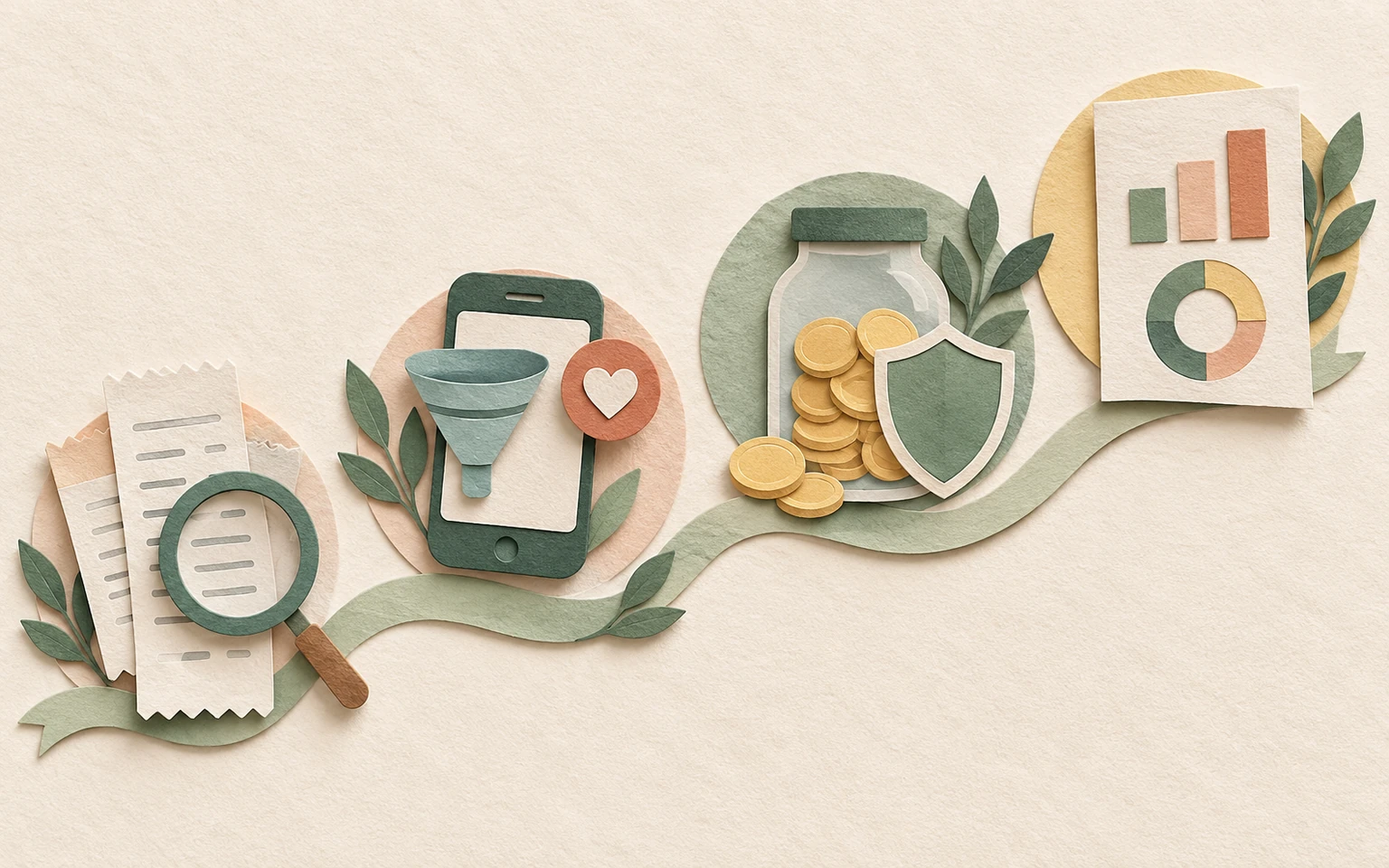
8. How Tracking Your Own Numbers Helps
The counter to lifestyle FOMO is not louder motivation. It is clearer data about your own cash flow.
Simple Money Tracker is built around privacy-first tracking with low friction: log spending in the dashboard, use natural-language AI input, or capture transactions through Telegram. Sensitive vault data is encrypted on your device before synchronisation.
The point is not to shame every transaction. The point is to see the gap between income and spending, notice scattered BNPL-style commitments, and make the next choice with less guesswork. When your own three monthly metrics are visible, someone else’s weekend trip stops defining whether you are “behind.”
Start with one honest 30-day audit. The truth is often uncomfortable, but it is the only reliable starting point for regaining control.
Contextual next step
If you already use Simple Money Tracker, export or review the last 30 days tonight. If you do not, a notebook and three monthly metrics are enough to begin.
9. Sources and Evidence Notes
Sources were checked on 27 September 2026. This article is a narrative synthesis of news reports, market trackers, and published research summaries—not a new systematic review. Survey figures from Vietnam are based on limited samples and should not be read as national prevalence rates. Thailand debt growth figures describe a different credit market and are used as a regional signal only.
The three-question mindset, four-step plan, and comparison filter are practical editorial frameworks. They are not tested together as an intervention and do not guarantee a financial outcome.
- Navigos Group (January 2026). 2026 Salary & Labour Market Report – Talent Guide 2026. Official release; see also Dân Trí coverage and APCDA Vietnam labour summary.
- Dân Trí (28 January 2026). “Văn hóa nợ mới” trong giới sinh viên. Survey of 173 people aged 18–35; 61.73% reported BNPL use.
- Research summarised via Kinh tế và Dự báo and Genk: 210 respondents aged 18–35; about 64.3% used BNPL in the past 12 months.
- Research and Markets: Vietnam Buy Now Pay Later market — approximately USD 2.14 billion (2025) with multi-year growth forecasts.
- NESDC / National Credit Bureau summaries reported by Nation Thailand: under-25 credit-card debt +13.5% and personal loans +11.5% in the cited 2025 window.
- Fear of missing out and consumer wellbeing: PLOS ONE study on FOMO, influencers, and social/psychological/financial wellbeing. Association study; not causal proof for every individual.
Continue This Series: Money Psychology & Better Habits
Next in the series, Why We Buy on Emotion—and How Online Shopping Speeds It Up explains the feeling → cue → checkout pathway behind many FOMO purchases.
When you are ready to strengthen the cash-flow side, read Saving vs. Earning More: The False Choice That Keeps People Stuck. For a concrete practice after your 30-day audit, see Viral Money-Saving Challenges: What Works, What Can Backfire.
To connect daily transactions with a longer personal story, Personal Finance Over Time is a useful companion piece.