

The workday went badly. You open your phone for a break. A creator demonstrates a product you had never considered buying. There is a discount, an enthusiastic comment section, and a checkout button. Minutes later, you have an order confirmation—and a small sense that the day has improved.
Or perhaps the day went wonderfully. You finished a difficult project and want a reward. The purchase feels like a celebration of the person you are becoming. Both stories can end with something useful, something enjoyable, or something you barely use.
This article is for people who recognise that gap between their spending intentions and their shopping decisions. The useful question is what the purchase is doing for you, and whether its full cost fits the life you want after the moment has passed.
By Simple Money Tracker · Money Psychology & Better Habits · Published 13 September 2026.
1. Emotional Spending, Impulse Buying, and Compulsive Buying Are Different
Here, emotional spending means a purchase partly motivated by changing or expressing a feeling. It can be deliberate: you budget for a birthday meal because sharing it will make you happy. Emotion is part of what makes the meal valuable.
Impulse buying involves a sudden urge to purchase with little advance deliberation. An unplanned purchase is not automatically an impulse purchase: noticing that you need replacement batteries can simply be remembering a practical need.
Compulsive buying-shopping describes a more serious pattern involving impaired control and harmful consequences. The distinction matters because an occasional unnecessary purchase does not establish a disorder, while persistent loss of control deserves more support than a budgeting slogan.
For the research distinctions, see Iyer and colleagues’ review of impulse buying and Müller and colleagues’ clinical review.
Enjoyment is a legitimate reason to spend
A purchase can be emotional, considered, and affordable. Assess the decision by its purpose, cost, and consequences—not by whether it produces pleasure.
2. A Feeling Can Change What a Product Seems Worth
In a 2004 experiment, Jennifer Lerner, Deborah Small, and George Loewenstein found that emotions induced by an unrelated situation carried into decisions involving real money. Sadness increased buying or choice prices while reducing selling prices. Disgust reduced both. Two unpleasant feelings produced different economic responses. [Lerner et al., 2004]
This supports a precise claim: an incidental emotion can influence valuation under experimental conditions. It does not mean every sad person spends more, that all negative emotions work alike, or that a particular mood adds a predictable percentage to your bill.
For an everyday illustration, imagine considering the same headphones on two evenings. On one, they are a possible replacement. On the other, after a discouraging meeting, they represent comfort and a fresh start. The specifications have stayed the same; the emotional job you want the product to do has changed.
Before comparing brands, write one sentence: “I want this because…” Include the emotional answer if there is one. “I want better sound” and “I want to feel rewarded” may both be true. Naming both gives you two questions to evaluate.
3. Retail Therapy Can Bring Relief, but Relief Has Limits
Scott Rick, Beatriz Pereira, and Katherine Burson tested a specific explanation for retail therapy in three experiments: choosing can restore a sense of personal control and reduce lingering sadness. Benefits appeared in both hypothetical and real shopping decisions, and did not generalise to anger. In the first experiment, 100 adults made choices without actually receiving the products. [Rick et al., 2014]
The distinction is useful. Some relief may come from exercising choice, rather than from ownership itself. These experiments do not establish that repeated shopping improves long-term wellbeing, treats depression, or remains beneficial when it creates debt.
A practical interpretation is to try another act of agency before spending: choose tomorrow’s plan, prepare something you enjoy, or finish one small task. These are suggested alternatives, not interventions tested against shopping in that paper. You can then decide whether you still want the item.
4. How a Feeling Becomes a Purchase
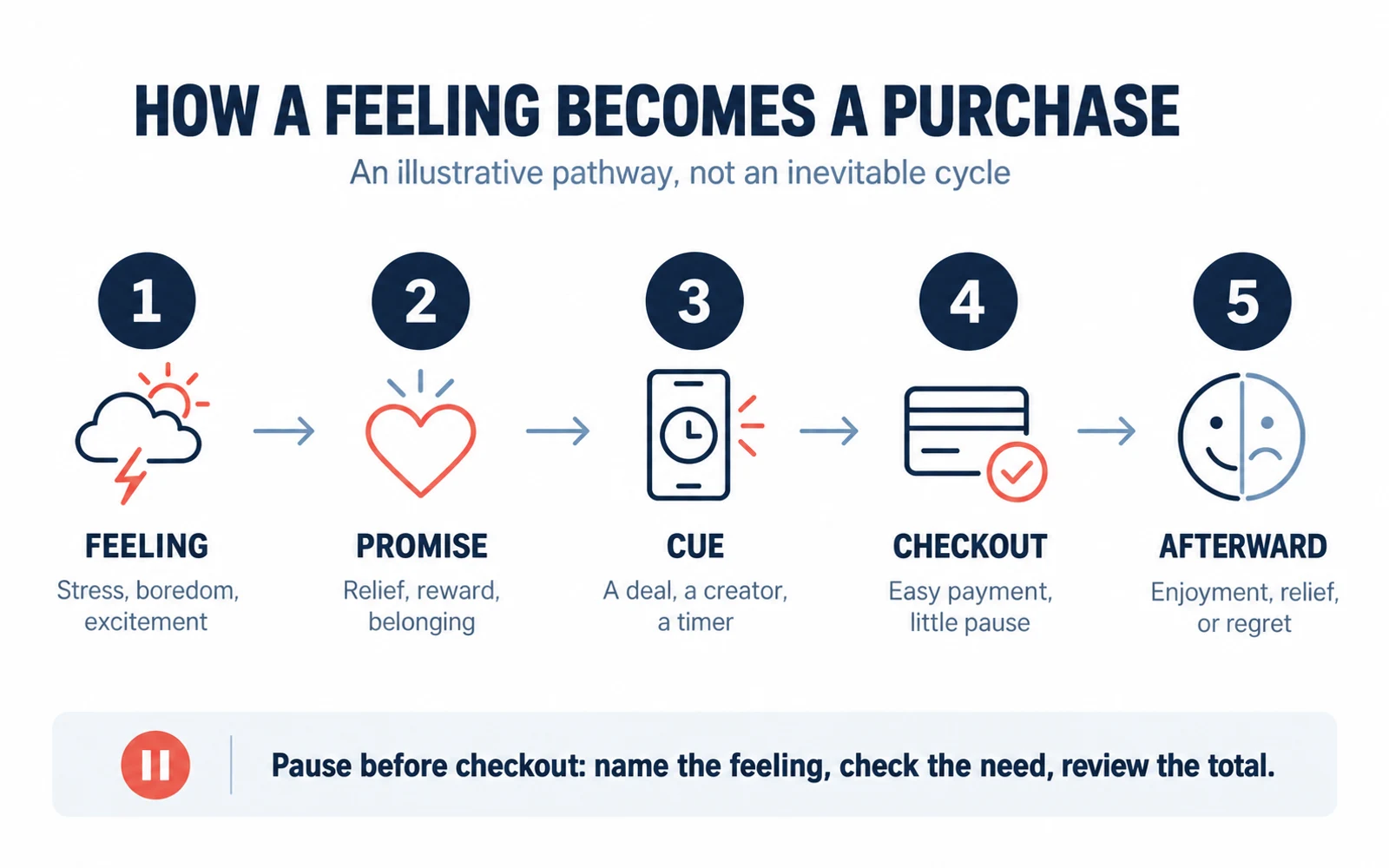
A useful way to inspect an episode is to separate five stages: feeling, promise, cue, checkout, and afterward. This is an illustrative framework for reflection, not a universal psychological sequence. Sometimes an advertisement creates the feeling rather than following it.
Feeling: something changes your state—boredom, sadness, excitement, or pressure. Promise: the item seems to offer relief, reward, belonging, or a new identity. Cue: a discount, creator, or timer makes acting now attractive. Checkout: payment is easy enough to complete before a fuller review. Afterward: the result may be enjoyment, relief, indifference, or regret.
Consider two fictional shoppers. One buys a jacket after feeling left out of a social event. Another buys an expensive keyboard after a difficult week, describing it as a productivity upgrade. Neither product category tells us whether the purchase makes sense. We would need to know what they already own, how they will use the item, and what the money was meant to cover.
The infographic summarises this pathway. Its arrows describe a possible sequence; they do not imply that each stage inevitably causes the next.
5. Recognise the Need Beneath the Shopping Urge
Use the examples below as questions to test against your experience. They are not a diagnostic scale or a list of proven one-to-one relationships between moods and purchases. The same emotion can lead different people to shop, save, withdraw, or do something else entirely.
| What you notice | What you may be seeking | A question or alternative to try |
|---|---|---|
| Stress or sadness | Comfort or control | Would rest, a conversation, or one manageable task meet the immediate need? |
| Boredom | Novelty or stimulation | Try an activity with something you already own before browsing. |
| Loneliness or exclusion | Connection or belonging | Contact someone directly. Would you want the item without the audience? |
| Excitement or achievement | Celebration or recognition | Choose a reward within an amount you decided before shopping. |
| Insecurity about identity | Confidence or status | What will owning this let you actually do, beyond imagining a different self? |
| Fear of missing a deal | Avoiding a perceived loss | Compare buying with keeping the money, as well as with the advertised original price. |
6. A Good Deal and a Good Purchase Are Separate Judgments
Richard Thaler’s work on mental accounting describes how people label money, group spending into categories, and evaluate transactions. One useful distinction is between the value of what you acquire and the pleasure of getting an attractive deal. The label attached to money can also affect how available it feels to spend. [Thaler, 1999]
For an illustrative purchase, a bag marked down from 1,000,000 VND to 600,000 VND is 400,000 VND cheaper than that reference price. But if you would otherwise buy nothing, the decision reduces your available money by 600,000 VND. There is no 400,000 VND deposit into your savings account.
Likewise, suppose delivery costs 30,000 VND, and an unnecessary 100,000 VND add-on unlocks free delivery. Adding it increases your total outlay by 70,000 VND. It can make sense if you already need the add-on and the combined price is competitive. The free-shipping label alone cannot answer that question.
Try comparing three options: buy this item, buy a suitable cheaper alternative, or keep the money. Ask what you would give up in each case. A refund or bonus can have a useful purpose before it becomes permission for an unplanned upgrade.
7. Easy Payment Makes the Decision Shorter, Not the Bill Smaller
A 2024 meta-analysis by Lachlan Schomburgk, Alex Belli, and Arvid Hoffmann combined 392 effect sizes from 71 papers. It found a small but statistically significant tendency toward greater spending with cashless rather than cash payments. The effect varied with context and generally weakened over time. The review did not find evidence that payment-method features explained the effect’s size. [Schomburgk et al., 2024]
This is evidence about average spending outcomes across studies, not proof that your digital wallet causes overspending. It also does not isolate the effect of a specific one-tap button. Cashless payment, saved checkout details, and borrowing are related design choices, but they are not the same variable.
Our practical suggestion is to make the cost visible at the decision point: review the final total, then check the amount remaining for optional spending. If saved payment details make your own purchases too automatic, try removing them from the shopping service while keeping access to essential payments convenient.
For installment offers, add every payment and any applicable charges. Four payments of 300,000 VND total 1,200,000 VND before fees or interest. Put their due dates beside existing commitments; a smaller first payment does not reduce the purchase price. These numbers are examples, not terms of a particular credit product.
8. Livestreams Put Social Attention and Urgency Beside Checkout
A 2025 study by Thi Thuy An Ngo and colleagues collected 440 valid responses from TikTok Shop users in Vietnam through convenience sampling. Its statistical model linked time pressure, perceived economic benefit, social influence, entertainment, and emotional arousal with impulse buying. The direct paths from quantity pressure and information usefulness were not statistically significant. [Ngo et al., 2025]
This is relevant local evidence, with limits. A survey model can identify associations; it cannot establish that a countdown caused a particular purchase or represent all Vietnamese shoppers. The unsupported direct paths also caution against claiming that every scarcity cue always works.
As an illustration, a livestream can place product explanation, a friendly host, viewer reactions, and a purchase link in one continuous experience. The practical question is whether that setting gives you enough room to evaluate the product independently. Leave the stream and compare the offer on a plain product page before deciding.
There is also a difference between a genuine deadline and a fabricated one. The US Federal Trade Commission’s 2022 dark-patterns report describes misleading countdowns, hidden information, and designs that make cancellation difficult. A timer that resets deserves scrutiny; a real deadline still does not determine your need or budget. This is an example of documented design practices, not a claim about the legality of a specific platform in Vietnam. [FTC, 2022]
9. Fast Checkout and Fast Delivery Are Different Accelerators
There are two clocks in an online purchase. The decision clock runs from first interest to placing the order. The fulfillment clock runs from placing the order to receiving it. Saved addresses and payment details shorten the first; faster logistics shorten the second.
The prospect of using an item this evening may make it more attractive than receiving it next week. That is a plausible interpretation of the appeal of quick delivery, not a causal effect size established by the payment and TikTok studies above. Those studies do not isolate delivery speed from price, convenience, product need, or customer selection.
An important correction follows: waiting for a parcel is not the same as waiting before buying. Once you order, you may already have paid or committed to payment. Cancellation and returns depend on the seller’s terms and your situation. A slower courier therefore does not automatically provide an effective cooling-off rule.
For optional purchases, place the deliberate pause before checkout. For necessities, convenience may be worth paying for. The goal is to preserve your decision time where it helps, rather than to make all shopping difficult.
10. Gender Stereotypes Are a Poor Spending Plan
It would be inaccurate to say research finds no gender differences. Iyer and colleagues’ meta-analysis integrated 231 samples involving more than 75,000 consumers and found an average gender association consistent with greater impulse buying among women. It also concluded that demographic factors mattered less for prediction than several psychological and situational factors. [Iyer et al., 2020; first published online 2019]
That does not establish an innate difference in rationality, or justify universal claims that men buy less often but always spend more per transaction. Category preferences, household purchasing responsibilities, measurement, and context need separate examination. A specification-heavy purchase can still express status or reward; a fashion purchase can be researched and budgeted.
Studies of compulsive buying answer another question. A 2006 US survey reported estimated rates of 6.0% among women and 5.5% among men. Those historical screening estimates are neither current prevalence figures nor evidence that everyday impulse buying is identical across genders. [Koran et al., 2006]
For your own finances, inspect both frequency and amount. Ten optional purchases of 100,000 VND and one of 1,000,000 VND use the same money. A useful review asks which decisions you would repeat, which met a real purpose, and which displaced something more important.
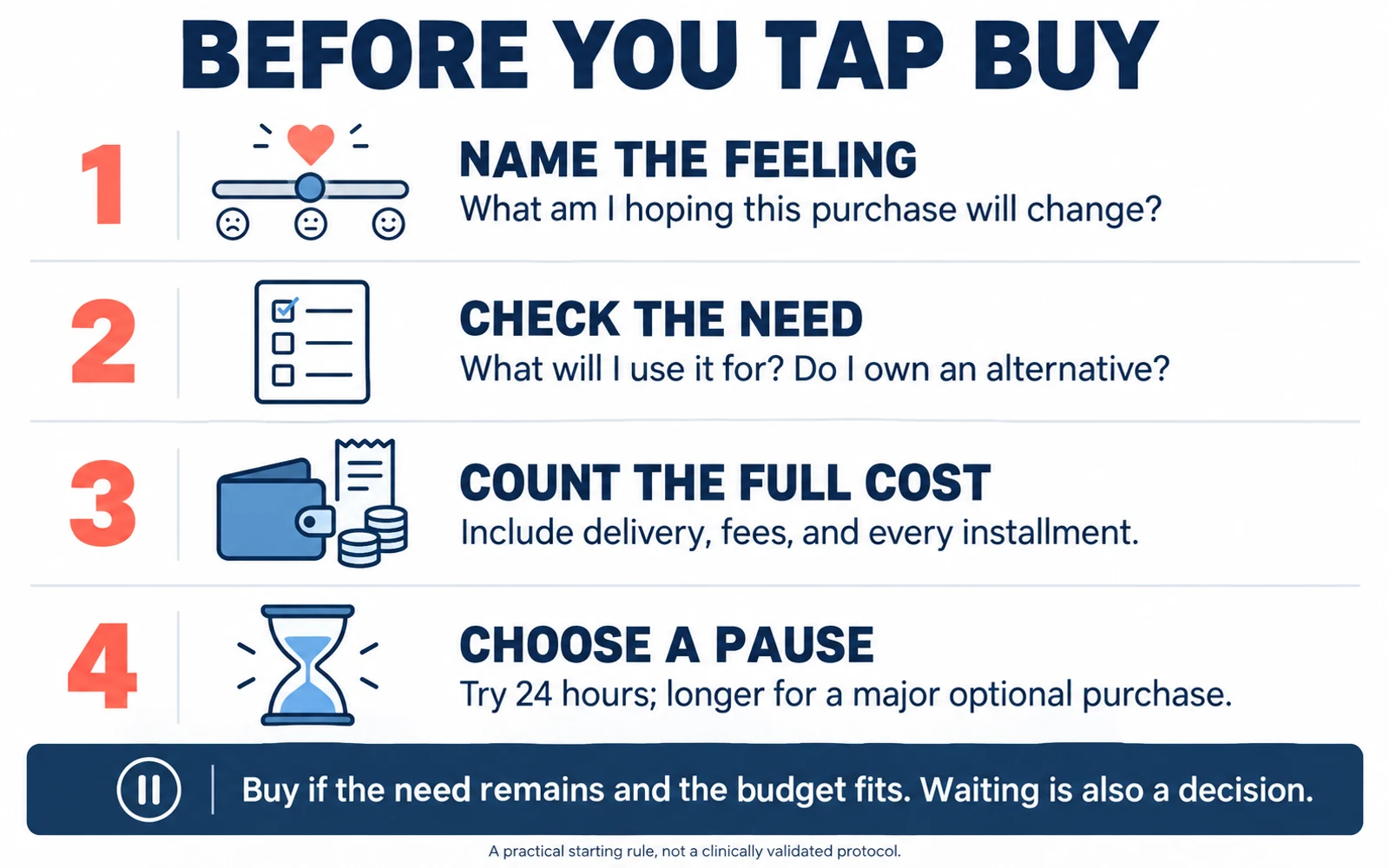
11. Before You Tap Buy: Four Questions and a Deliberate Pause
Use this as a starting routine for optional purchases. It is an editorial exercise, not a clinically validated protocol, and it does not guarantee that a purchase will be sensible after a set number of hours.
- Name the feeling. What am I hoping this purchase will change? Am I celebrating, avoiding discomfort, trying to belong, or solving a practical problem?
- Check the need. When will I use this? What do I already own that serves the same purpose? Would I want it without the creator, audience, or countdown?
- Count the full cost. Include delivery, fees, accessories you actually need, recurring charges, and all installments. Check what remains after essentials and existing commitments.
- Choose a pause. Try 24 hours for an ordinary optional purchase, or seven days for something expensive relative to your available money. Write it on a list outside the shopping app and set a review date. Do not delay urgent necessities to obey the rule.
One question has direct experimental support: what else could this money do? Frederick and colleagues found that prompting people to consider opportunity costs changed purchase choices. A later meta-analysis covering 39 experiments and 14,005 participants found a smaller effect than the original studies, and noted that the decisions were predominantly hypothetical. These findings support making alternatives explicit, not promising a particular amount of real-world savings. [Frederick et al., 2009] [Maguire et al., 2023]
At the review date, buying remains an option. The need may survive the pause and fit your budget. Also refine the popular “Would I buy it at full price?” test: refusing full price can simply mean you have a sensible price ceiling. The stronger test is whether the actual price is worth paying given the alternatives.
12. Turn Good Intentions into One Specific Rule
“I will spend less” leaves the difficult moment unspecified. An if–then plan chooses a response in advance: “If I open a shopping app after a stressful meeting, then I will close it, note the item, and review it tomorrow.” Gollwitzer and Sheeran’s meta-analysis found that such implementation intentions supported goal achievement across 94 tests. This was broad goal-setting research, not validation of this particular shopping rule. [Gollwitzer & Sheeran, 2006]
Choose one adjustment you can actually maintain: silence shopping promotions, unfollow a trigger account, remove a shopping shortcut, or check your optional-spending balance before browsing. These are practical experiments rather than a ranked list of proven treatments. Keep the one that helps your observed pattern.
Leave room for planned enjoyment when your cash flow allows it. For example, you might set aside a small amount for a celebratory meal before choosing the venue. If no money remains after essentials, the immediate task is reviewing income, bills, and available support. That arithmetic should not become a judgment about your self-control.
13. A 14-Day Experiment: Track the Trigger as Well as the Amount
For two weeks, make a short note when you feel a noticeable urge to buy something optional. Record urges you do not act on as well as purchases. A spending ledger alone cannot show the decisions that ended with keeping the money.
Write the date, item, full price, feeling beforehand, trigger, intended use, and decision: bought, postponed, or declined. Later, add whether you used it and how you feel about the decision. Keep the record private and brief enough that you will use it.
Here is a fictional entry: “Tuesday, 22:30; headphones; 800,000 VND; frustrated; creator review; hoped-for reward; existing headphones work; postponed.” At Friday’s review, the person decides against buying. That is a recorded decision, not proof that all late-night purchases are mistakes.
At the end, look for patterns: which situations preceded urges, which categories accumulated, and which purchases you still value. Change one recurring trigger next. Two weeks is a convenient observation window, not enough to prove cause and effect; income changes, unusual events, and chance can affect the result.
Do not count the retail price of every declined item as savings. A 3,000,000 VND wishlist that you were never going to purchase is not 3,000,000 VND saved. Track actual spending and money retained, and check whether postponed spending simply reappears later.
A notebook or private spreadsheet is enough. If you already use Simple Money Tracker, record the transaction there and keep a short accompanying note about its context. The My Mood article explains the product’s mood-journaling approach; a mood record is a reflection aid, not a diagnosis or proof of why a purchase happened.
14. When a Shopping Checklist Is Not Enough
If buying repeatedly feels out of control, continues despite serious consequences, or interferes with relationships, work, and basic responsibilities, seek assessment from a qualified mental-health professional. These patterns matter more than the label “shopaholic.” A spending checklist cannot diagnose or treat them. [Müller et al., 2023]
The same review found promising results for group cognitive behavioural therapy, but the treatment evidence had substantial methodological and reporting limitations, and none of its included studies specifically addressed online buying-shopping disorder. Help should therefore be tailored to the person, not presented as a guaranteed shopping detox.
For everyday decisions, give yourself enough space to connect a feeling with a purpose and a cost. Sometimes that means buying something you will enjoy. Sometimes it means meeting the emotional need another way and keeping the money available.
Sources and Evidence Notes
This article is a narrative synthesis of experiments, research reviews, and regulatory documentation, checked on 13 September 2026. It is not a new systematic review. Laboratory effects, survey associations, historical prevalence estimates, and practical suggestions are distinguished throughout. Where full text was unavailable, claims were restricted to the authors’ accessible abstracts.
The fictional examples, reflection pathway, waiting periods, and 14-day exercise are editorial suggestions. They are not tested together as an intervention. Monetary examples are arithmetic demonstrations, not recommended budgets. Illustrations are explanatory artwork and do not represent measured data.
- Lerner, J. S., Small, D. A., & Loewenstein, G. (2004). Heart Strings and Purse Strings: Carryover Effects of Emotions on Economic Decisions. Psychological Science, 15(5), 337–341. Experimental evidence; publisher abstract.
- Rick, S. I., Pereira, B., & Burson, K. A. (2014). The benefits of retail therapy: Making purchase decisions reduces residual sadness. Journal of Consumer Psychology, 24(3), 373–380. Three experiments; author-hosted full text.
- Iyer, G. R., Blut, M., Xiao, S. H., & Grewal, D. (2020; online 2019). Impulse buying: a meta-analytic review. Journal of the Academy of Marketing Science, 48, 384–404. Publisher full text.
- Thaler, R. H. (1999). Mental Accounting Matters. Journal of Behavioral Decision Making, 12(3), 183–206. Research synthesis; university-hosted full text.
- Schomburgk, L., Belli, A., & Hoffmann, A. O. I. (2024). Less cash, more splash? A meta-analysis on the cashless effect. Journal of Retailing, 100(3), 382–403. Publisher-indexed abstract and methods; university repository copy.
- Ngo, T. T. A., Nguyen, H. L. T., Mai, H. T. A., & Nguyen, H. P. (2025). Key determinants of online impulse buying behavior: A study from TikTok Shop users in Vietnam. Acta Psychologica, 260, 105593. Convenience-sample survey; PubMed abstract.
- Federal Trade Commission (September 2022). Bringing Dark Patterns to Light. Staff report and accompanying official summary.
- Koran, L. M., Faber, R. J., Aboujaoude, E., Large, M. D., & Serpe, R. T. (2006). Estimated prevalence of compulsive buying behavior in the United States. American Journal of Psychiatry, 163(10), 1806–1812. Historical survey; indexed abstract.
- Frederick, S., Novemsky, N., Wang, J., Dhar, R., & Nowlis, S. (2009). Opportunity Cost Neglect. Journal of Consumer Research, 36(4), 553–561. Experiments; university research record.
- Maguire, A., Persson, E., & Tinghög, G. (2023). Opportunity cost neglect: a meta-analysis. Journal of the Economic Science Association, 9, 176–192. Full text; the Cambridge hosting page also carries a 2025 online date.
- Gollwitzer, P. M., & Sheeran, P. (2006). Implementation Intentions and Goal Achievement: A Meta-analysis of Effects and Processes. Advances in Experimental Social Psychology, 38, 69–119. Indexed abstract and university publication record.
- Müller, A., et al. (2023). Update on treatment studies for compulsive buying-shopping disorder: A systematic review. Journal of Behavioral Addictions, 12(3), 631–651. Full text; treatment-evidence limitations.
Continue This Series: Money Psychology & Better Habits
To turn a spending review into a manageable next step, read Viral Money-Saving Challenges: What Works, What Can Backfire. Choose an affordable practice after reviewing what your cash flow can support.
For a broader view of your own patterns, Personal Finance Over Time connects individual transactions with the longer story. Start with one honest entry and one decision you want to understand better.