

Two loud philosophies dominate nearly every corner of modern personal finance content.
On one side stands the frugality camp: cut every subscription, brew your own coffee, eliminate dining out, and squeeze every cent. On the other is the income-maximalist camp: a small purchase cannot matter, so put every spare hour into a promotion, freelance work, or a business.
Both ideas contain a useful truth and both fail when treated as the whole plan. Extreme restriction meets a real spending floor. Higher income without boundaries can disappear into a higher-cost lifestyle. The question is not which side wins; it is which lever is the current bottleneck.
A durable approach protects essential needs, creates a repeatable savings habit, and then directs time and money toward opportunities that can improve future income. This article is educational, not individual financial, tax, or investment advice.
By Simple Money Tracker - Money Psychology & Better Habits - Published 15 September 2026.
1. The Asymmetry of the Two Financial Levers
Start with the monthly identity that you can observe:
Net cash flow = take-home income - essential spending - discretionary spending - debt payments
A positive number is not the same as wealth: taxes, debt balances, investment returns, and inflation still matter. But it is the margin from which a household can build a buffer, pay down debt, or invest.
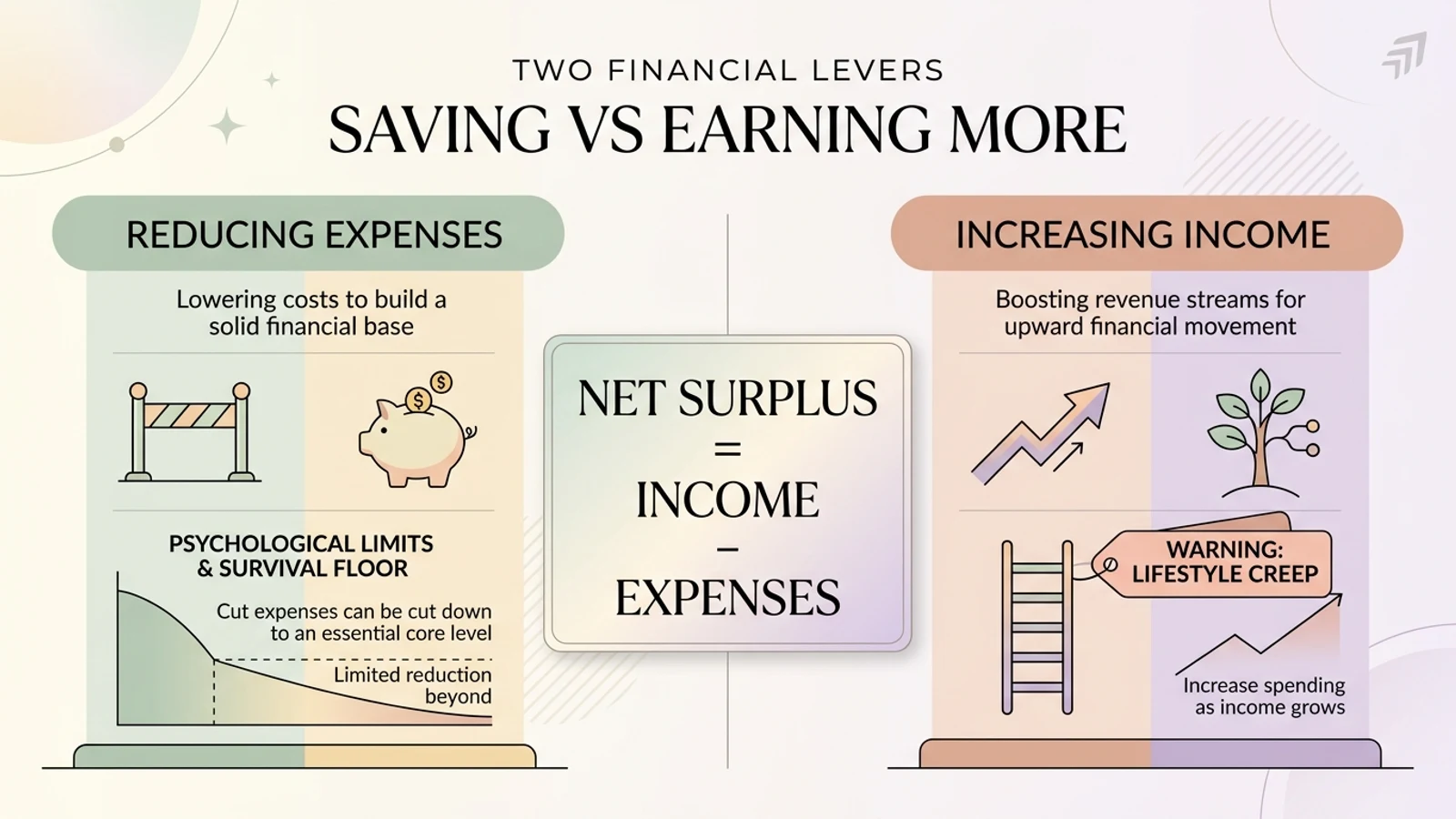
Reducing expenses has a floor. Housing, food, healthcare, transport, caregiving, and the ability to participate in ordinary life have real costs. Near that floor, further cuts may be small, fragile, or shift costs into health, time, and relationships.
Income also has real limits: health, caring duties, local labour markets, discrimination, available time, and the risk of a new venture. It is not guaranteed or limitless. Still, an increase in income can enlarge the margin beyond what trimming small discretionary costs can do, particularly once obvious waste has already been removed.
Research on scarcity argues that pressing financial constraints can capture attention and reduce the mental room available for other decisions. It does not mean that a person with little money is incapable of good decisions; it is a reason to design simpler systems and avoid treating deprivation as a moral test. [Mullainathan & Shafir, 2013]
Defense vs. Offense
Expense reduction is your defense; income expansion is your offense. You cannot win a game on defense alone, but you will quickly lose if your goal has no keeper.
2. Do Not Build a Plan from an Outlier
Online money stories reward extremes: someone who saves an unusually high share of a very low income, or someone whose lifestyle appears lavish on a fast-rising income. A story can be true and still be a poor template for a reader with different health, family, housing, debt, or job conditions.
Treat viral claims as prompts for questions, not instructions. What was the person's take-home pay? Were housing, healthcare, or family costs subsidised? Is the schedule safe and repeatable? What debt, benefits, or risks are omitted? Without those answers, headline savings totals reveal very little about the system behind them.
The same skepticism applies to luxury content. Visible consumption cannot show the emergency fund, debt, insurance, or future obligations behind the camera. A useful plan is one you can maintain through an ordinary month and a difficult one.
3. The Silent Wealth Killer: Lifestyle Creep
Lifestyle creep, or lifestyle inflation, is the tendency for spending to rise as income rises. It is not inevitable, and spending more on safety, family, time, or joy is not a failure. The risk begins when new recurring commitments consume every raise before you have chosen what the raise is for.
Income can improve well-being, especially when it relieves material constraints. But researchers also find evidence that people adapt to changes in income and status over time. That is one reason a new salary can feel normal surprisingly quickly, rather than a reason to avoid earning more.
The most consequential upgrades are usually recurring: a larger lease, car payment, subscriptions, school fees, or a routine that requires a more expensive baseline. They are harder to unwind than a one-time treat. A household earning 80,000,000 VND per month with 78,000,000 VND of recurring commitments has less room for a shock than one earning 25,000,000 VND and spending 15,000,000 VND - all else equal.
The following infographic illustrates how the floor of cost reduction and the ceiling of income interact, along with the lifestyle creep trap.
4. Make the System Easier Than the Decision
A plan that requires dozens of perfect daily decisions will fail more often than a plan with a few clear defaults. Do not make every coffee, meal, or small pleasure carry the weight of a life-changing decision.
Instead, choose a small number of review points: a weekly spending check, a monthly transfer, and a waiting rule for purchases above a personally meaningful threshold. Leave a deliberate amount for enjoyment. This separates ordinary living from the choices that materially affect your margin.
After a demanding week, a reward can be a legitimate need rather than a character flaw. The practical safeguard is to decide its budget before the stressful moment arrives, and to delay a large unplanned purchase long enough to compare it with your existing goals.
Sustainable Margin Over Martyrdom
The objective is not to prove how much hardship you can endure. It is to build a margin that survives ordinary life and leaves room for a life you value.
5. The 4-Step Sequence to Durable Wealth
Saving and earning are not rival identities. They work best as parts of one system. Use this four-step sequence as a starting point, then adapt it to your job stability, dependants, debt terms, insurance, and local safety nets:
1. Protect the next shock: Calculate essential monthly spending and start a separate cash buffer. The right target is personal: consider the surprises you have faced, income stability, and who relies on you. Even a small buffer can reduce the need to borrow after an emergency.
2. Set a realistic automatic baseline: Schedule a modest transfer just after payday, but leave enough in the spending account for known bills. If cash flow is irregular, transfer a percentage of each payment or save in higher-income months. Review the rule after one or two cycles instead of letting fees or overdrafts turn it into a setback.
3. Address expensive debt and build earning power: Compare the guaranteed cost of high-interest debt with the expected, uncertain return from investing or training. Then choose the highest-value next move: negotiating compensation, improving a job-relevant skill, finding a better role, or creating a carefully scoped second income stream.
4. Assign every raise before it arrives: A 50/50 split between future goals and quality of life is a useful default, not a law. Someone with expensive debt may choose more for repayment; someone who has deferred an essential need may choose more for life now. The key is to decide the split before the new income becomes ordinary spending.
A 2022 CFPB study of users of one savings app found that guaranteed rules, such as saving every payday, were associated with larger savings gains than rules triggered by spending or other events. This is not proof that automation works the same way for everyone, but it supports making a consistent rule easier to follow. [CFPB, 2022]

6. Three Practical Exercises to Run This Weekend
To put this dual-engine model into practice, try these three diagnostics this weekend:
- The essential-versus-flexible audit: Categorize the last 90 days of transactions into essential commitments (housing, utilities, debt minimums, basic groceries, transport, care) and flexible choices. Mark annual or irregular costs too. This identifies the cash-flow floor without pretending every expense is optional.
- The opportunity audit: List one income-improving action that fits your actual capacity this month: update a portfolio, ask for a compensation conversation, complete a job-relevant module, or contact a potential client. If time is scarce because of work or care, name that constraint instead of treating it as a personal failure.
- The raise-and-windfall rule: Before your next bonus, tax refund, or pay increase arrives, write down where it goes: a buffer, high-cost debt, a future goal, and a small amount you can enjoy. Put the first transfer on the calendar immediately.
7. How Simple Money Tracker Protects Your Financial Clarity
Tracking expenses should not become a punitive audit. The point is to see cash flow clearly enough to choose one next action, not to shame yourself for every transaction.
Simple Money Tracker is designed around Zero-Knowledge privacy, low friction, and clear visibility. Sensitive vault data is encrypted on your device before synchronisation, so the service does not receive your unencrypted financial records or your master password.
Whether you log purchases in the web dashboard, use natural-language AI input, or use the Telegram integration, the goal is the same: see the gap between income and spending, notice recurring commitments, and make the next choice with less guesswork.
Start tracking the gap that truly matters today, and let your savings and earnings work in harmony.
Build Your Own System
True financial freedom is not about deprivation or mindless hustle. It is about knowing your numbers, protecting your downside, and intentionally directing your surplus toward the life you want.
8. Sources and Evidence Notes
Sources were accessed on 16 September 2026. The CFPB evidence is based on United States consumers and an app-user sample; it supports the general discussion of emergency savings and saving habits, not a universal savings target or a recommendation for a Vietnamese banking product.
The VND and USD amounts in this article illustrate cash-flow arithmetic only. They are not recommended budgets, income targets, or investment advice. Consider local consumer protections, taxes, interest rates, debt terms, and professional advice where appropriate.
- CFPB: An essential guide to building an emergency fund - why the target should fit personal circumstances and why even a small reserve can help.
- CFPB: Consumer Savings App Strategies and Savings Outcomes (2022) - observational evidence on savings rules in one app.
- NBER: Happiness Adaptation to Income and to Status in an Individual Panel - longitudinal evidence relevant to adaptation after income changes.
- Mullainathan & Shafir: Scarcity (2013) - the attention and bandwidth framework discussed above.