Telegram Hybrid Bridge
Bridging convenience and security. How we use Envelope Encryption to protect your data as it moves from Telegram to your secure Vault.
The "Sealed Letter" Analogy
Imagine sending a valuable package through a courier. How do you ensure only the recipient can open it—even the courier can't peek?
1. The Inner Package
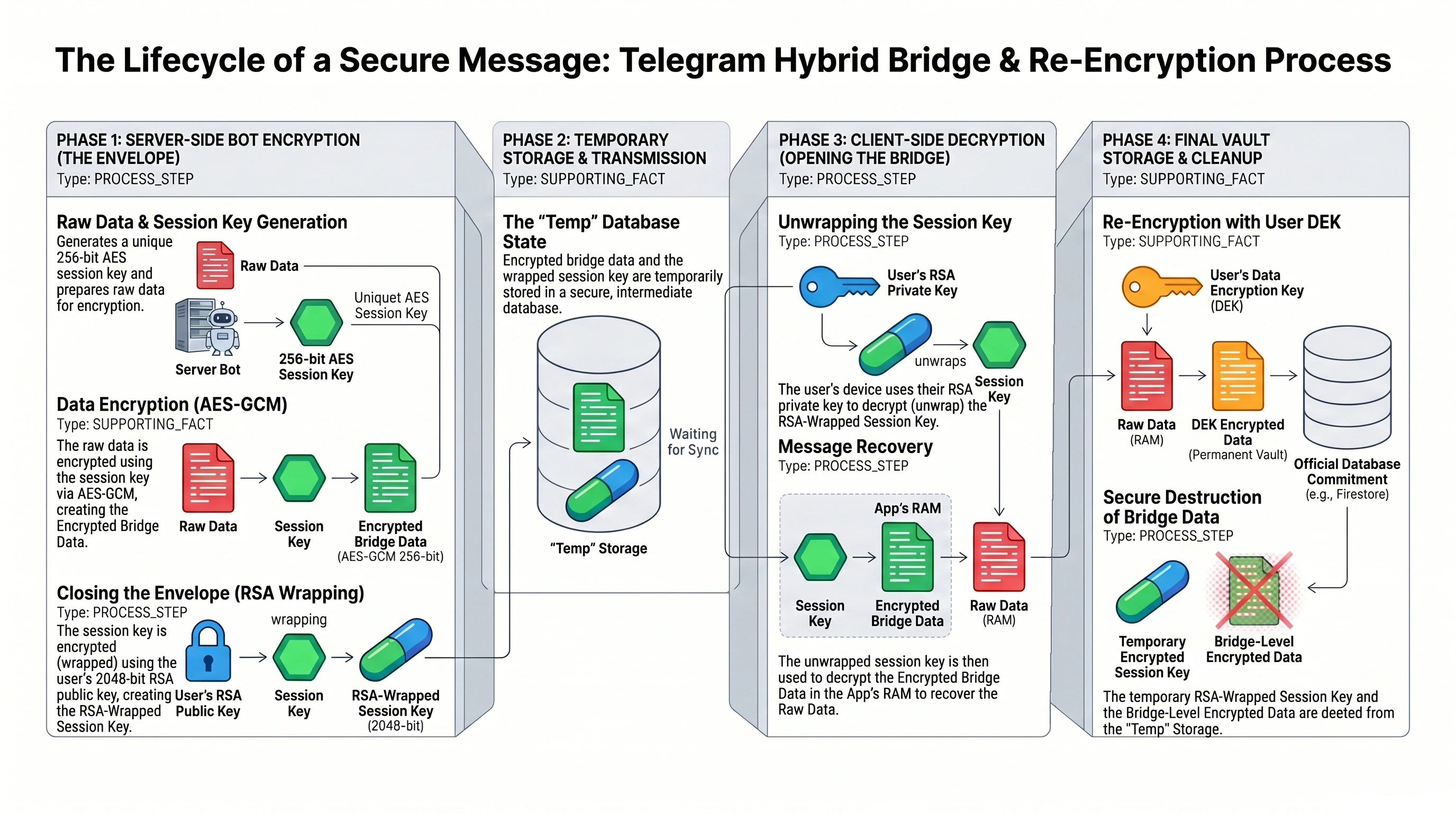
Your Telegram message is like a letter placed inside a locked box. The box is secured with a Session Key (one-time random key).
2. The Outer Envelope
The box is then placed inside a sealed envelope. This envelope can only be opened by the recipient using their Private Key.
The "Normalization" Step
When you open the app, your device:
- Uses your RSA Private Key to open the envelope
- Gets the Session Key to unlock the inner package
- Re-encrypts the message with your personal DEK
- Saves to your secure Vault and deletes the temporary bridge data
The Two-Layer Encryption
Your message is protected by not one, but TWO locks. Here's the complete journey from Telegram to your secure vault.
Payload
Session Key
Your Data is Always Encrypted
At every step, your information stays encrypted. The temporary storage cannot be read by anyone—not even us. Only when you log into the web app can your device decrypt and re-encrypt the data into your permanent vault.The server never sees your data in plain text.
Why It's Secure
Even though Telegram is involved, your data never exists in plain text on our servers.
One-Time Keys
Every message gets a brand new Session Key. Even if one key were compromised, only that message is affected.
No Server Access
Our server stores only the encrypted package. We never have the Session Key to decrypt anything.
Auto-Normalization
Within seconds of opening the app, all expenses from Telegram messages are re-encrypted with your permanent DEK.
"Your Telegram messages travel through a digital vault on rails—sealed at the source, only openable by your personal key."