
A colourful binder fills up with cash. A calendar gains another tick. Someone declines an expensive night out because they are saving for something that matters. Money-saving challenges turn an invisible intention into something you can see.
That is their appeal. The harder question is whether the money stays saved after the challenge ends. A completed envelope is little progress if you then borrow to pay for groceries.
This guide is for people who want a manageable first saving habit. We examine four familiar challenge formats and five supporting methods. The best fit depends on your available money, payment schedule, and the behaviour you want to change—not the size of somebody else’s online result.
By Simple Money Tracker · Money Psychology & Better Habits · Published 8 September 2026.
First, Decide What “Works” Means
Our editorial test is simple: can you repeat the rule, keep essentials funded, and finish with money still set aside? A challenge that needs borrowed money, missed bills, or an exhausting catch-up week fails that test even if every box is ticked.
Write down the income you can reasonably expect before your next payday, the bills due, essential spending, and a buffer. Choose a contribution from what remains. If nothing remains, start with a spending review or an income-and-bills plan; a savings streak is not a measure of your worth.
The FTC’s budgeting guide starts with income and expenses and recommends reviewing actual spending. That is the foundation beneath any challenge.
Check the hardest payment, not just the first one
Before starting, calculate the total, the largest contribution, and the amount required between paydays. You can reduce the unit, extend the schedule, or stop.
1. Cash Stuffing: Give Flexible Spending a Boundary
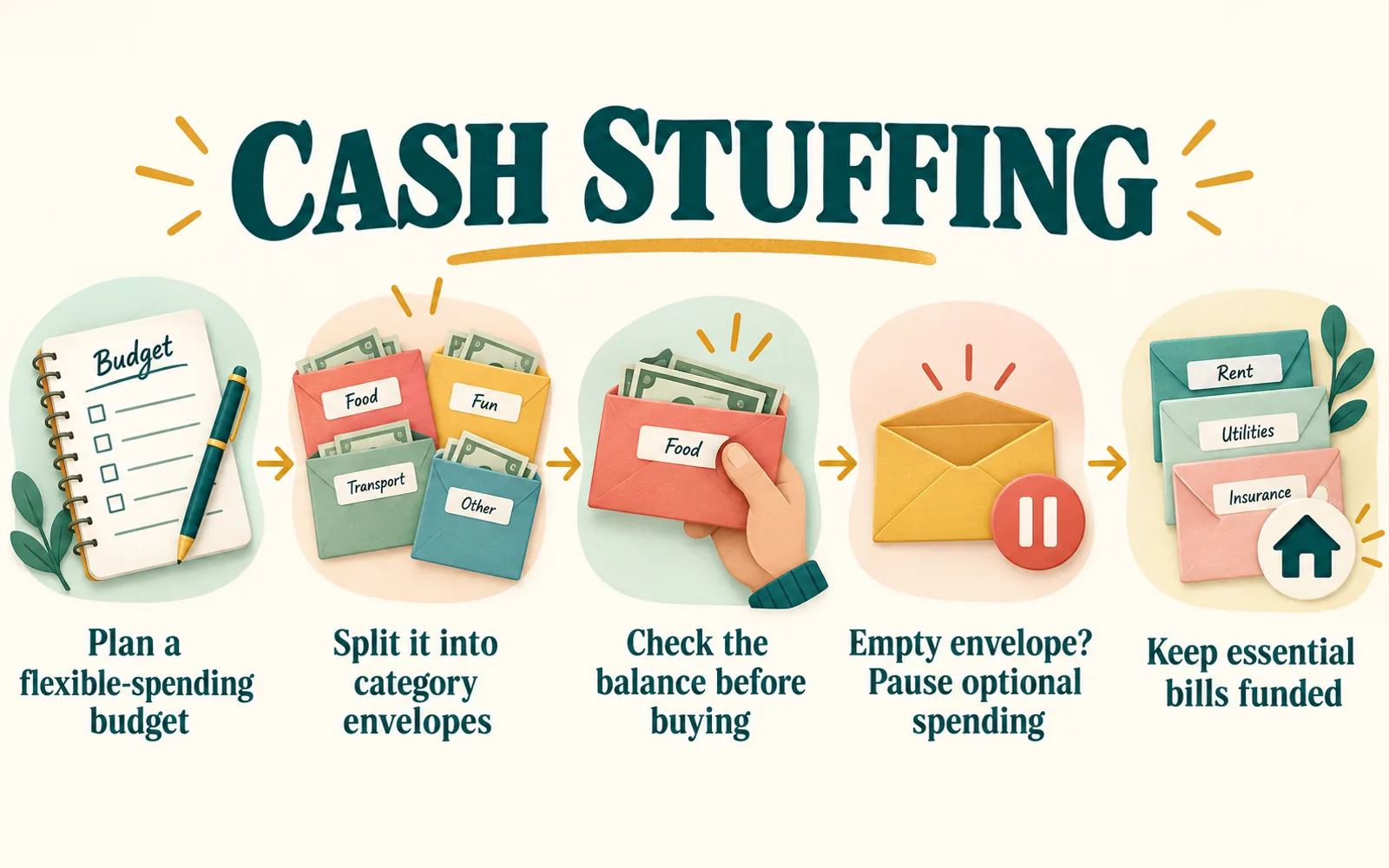
Divide a planned spending amount into category envelopes: groceries, transport, eating out, or entertainment. Record each purchase against its envelope. When the money for an optional category runs out, pause that spending or explicitly revise the plan.
For example, a 600,000 VND weekly flexible-spending budget could contain 350,000 for groceries, 150,000 for transport, and 100,000 for treats. These are demonstration numbers, not suggested living costs. Keep rent and other committed bills separate; an empty envelope does not mean skipping food or necessary transport.
Good fit: you want to see a category’s remaining money before buying. Watch out: withdrawing cash or moving it between pots is not itself saving. Only the unspent amount you retain counts.
Physical envelopes are optional. A written ledger or separate bank pots can represent the same limits. Check account fees, access, and protections locally; a digital pot does not automatically earn interest or carry deposit protection.
The CFPB’s emergency-fund guide notes that physical cash can be lost, stolen, or destroyed. Consider that trade-off before keeping substantial savings at home.
2. The 100-Envelope Challenge: Scale the Game Before Playing
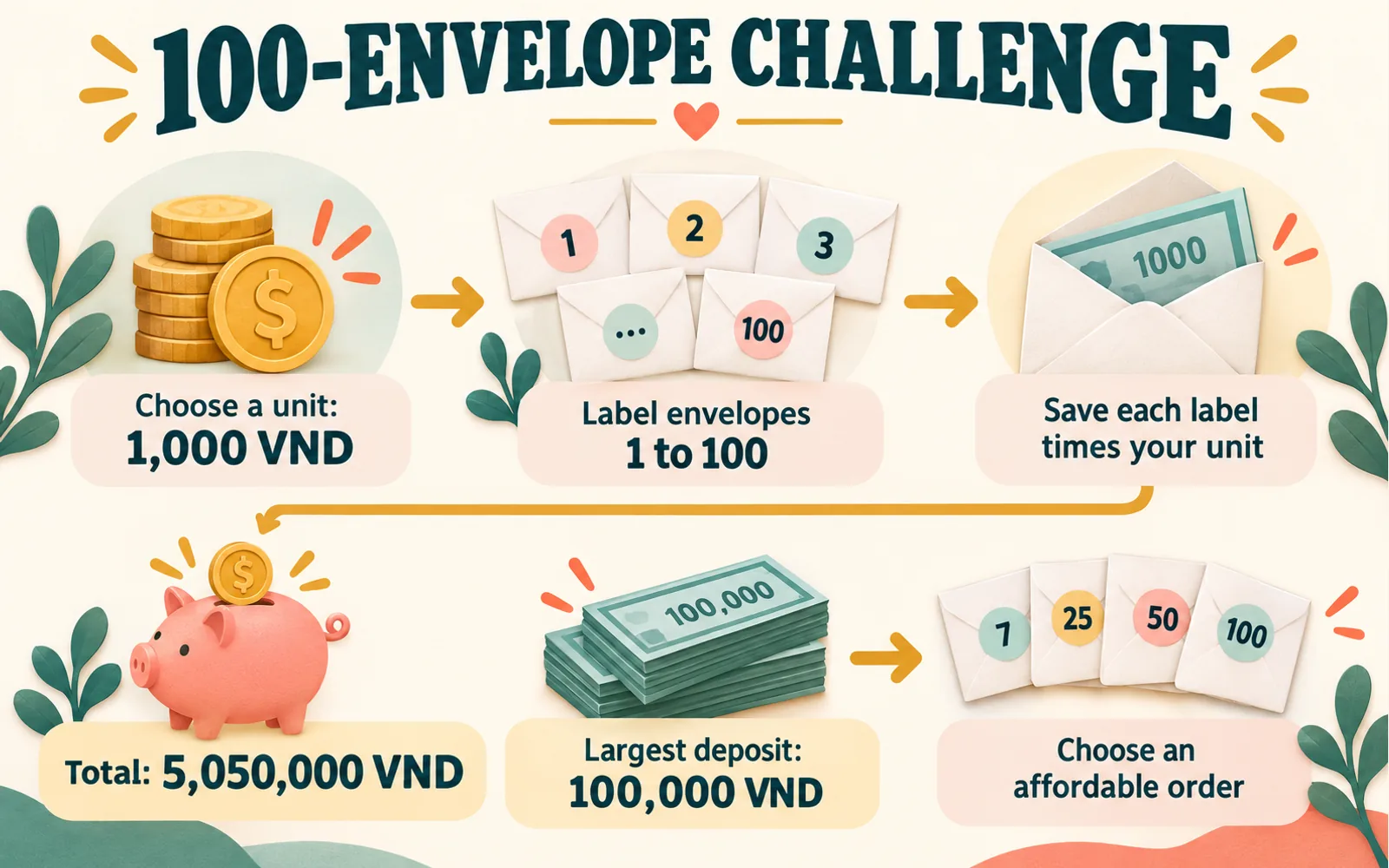
Label 100 envelopes from 1 to 100. Choose a monetary unit and fill each envelope once with its number multiplied by that unit. You can use a checklist instead of buying envelopes. The familiar one-dollar version totals $5,050 because 1 + 2 + … + 100 = 5,050.
With a 1,000 VND unit, the total is 5,050,000 VND and the largest deposit is 100,000 VND. With a 10,000 VND unit, those figures become 50,500,000 VND and 1,000,000 VND. Changing the currency is not a currency conversion: choose a unit based on affordability.
Random selection changes when the expensive envelopes arrive; it does not reduce the cost. Large deposits can appear at the beginning, middle, or end. At one envelope per week, completion takes 100 weeks, not one year.
Good fit: a visible checklist motivates you and the full schedule is affordable. Adaptation: pick envelopes that fit each pay period or reduce the unit. Stop rule: never borrow or take money from essential bills to fill a number.
3. The 52-Week Challenge: Small Starts, Larger Finish
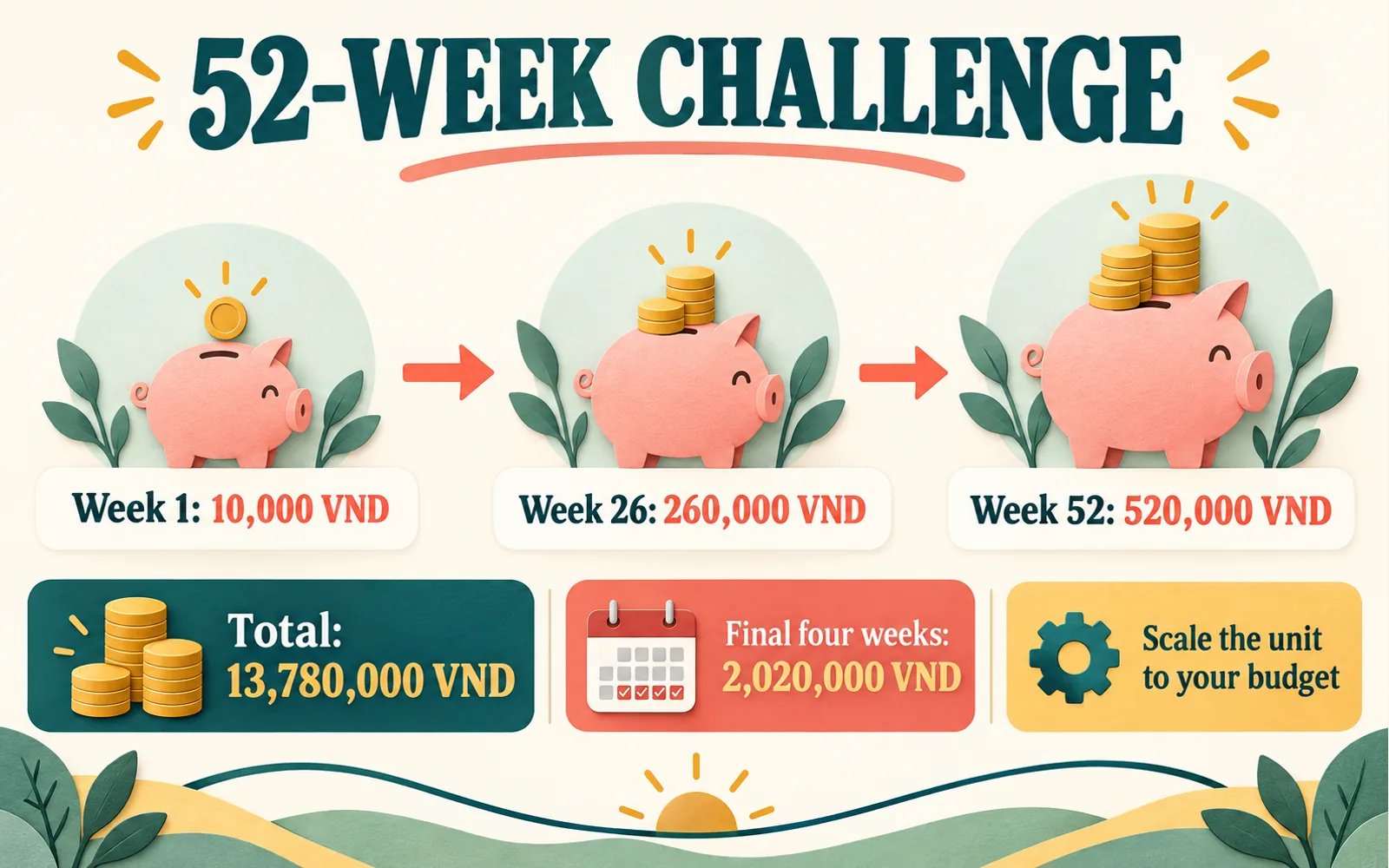
Choose a unit and save one unit in week 1, two in week 2, and so on through week 52. Total contributions equal 1,378 units: 52 × 53 ÷ 2.
At 10,000 VND per unit, week 1 requires 10,000 VND, week 26 requires 260,000 VND, and week 52 requires 520,000 VND. The full total is 13,780,000 VND. Weeks 49–52 alone require 2,020,000 VND, so a gentle beginning does not guarantee an affordable finish.
Reversing the order produces the same total and moves the hardest payments to the start. That can fit money you already have available, but irregular income alone does not make the reverse version suitable. A bonus that has not arrived cannot fund today’s transfer.
Good fit: you enjoy progressive goals and can plan for the larger weeks. Adaptation: use a smaller unit, or save a flat 265,000 VND each week for the same 13,780,000 VND total. Start in any week of the year.
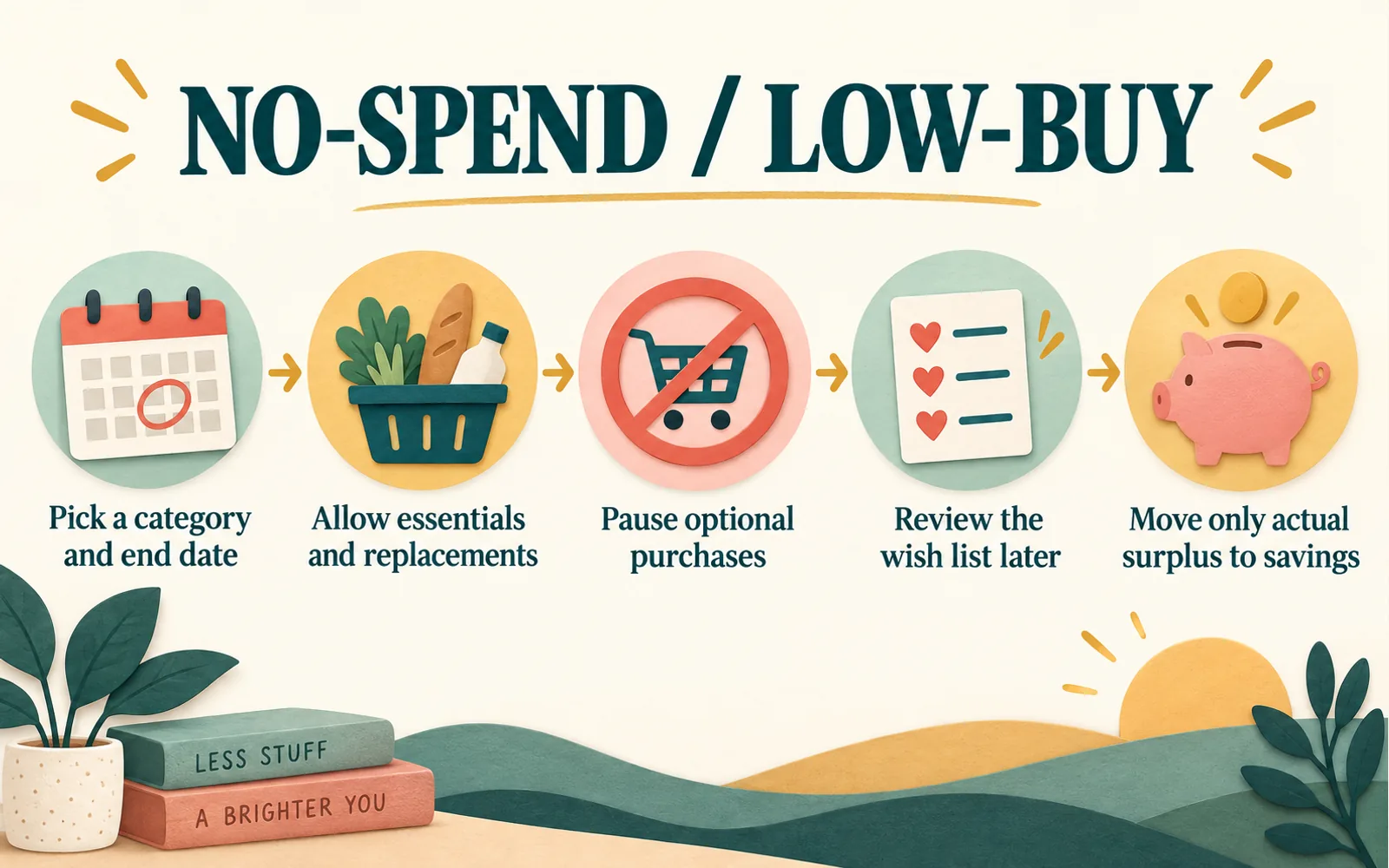
4. No-Spend and Low-Buy: Define What Is Still Allowed
A no-spend period pauses selected optional purchases for a defined window. A low-buy approach uses narrower rules, such as replacing worn-out clothing but postponing new outfits. Neither should prohibit food, medicine, necessary travel, or committed bills.
Try a seven-day pause on takeaway coffee, or a 30-day rule against buying unread books. Write the category, start date, end date, exceptions, and a plan for reviewing postponed purchases. Put interesting items on a wish list instead of treating the end date as a shopping deadline.
Good fit: you want to inspect an automatic purchase habit. Watch out: moving a purchase into next month is a delay, not necessarily a saving. Rebound spending is a possible failure mode to monitor, not an inevitable or quantified outcome claimed here.
If your usual optional spending is 200,000 VND and the experiment brings it to 80,000 VND, the difference is 120,000 VND. Check replacement costs and later spending before deciding how much you actually retained.
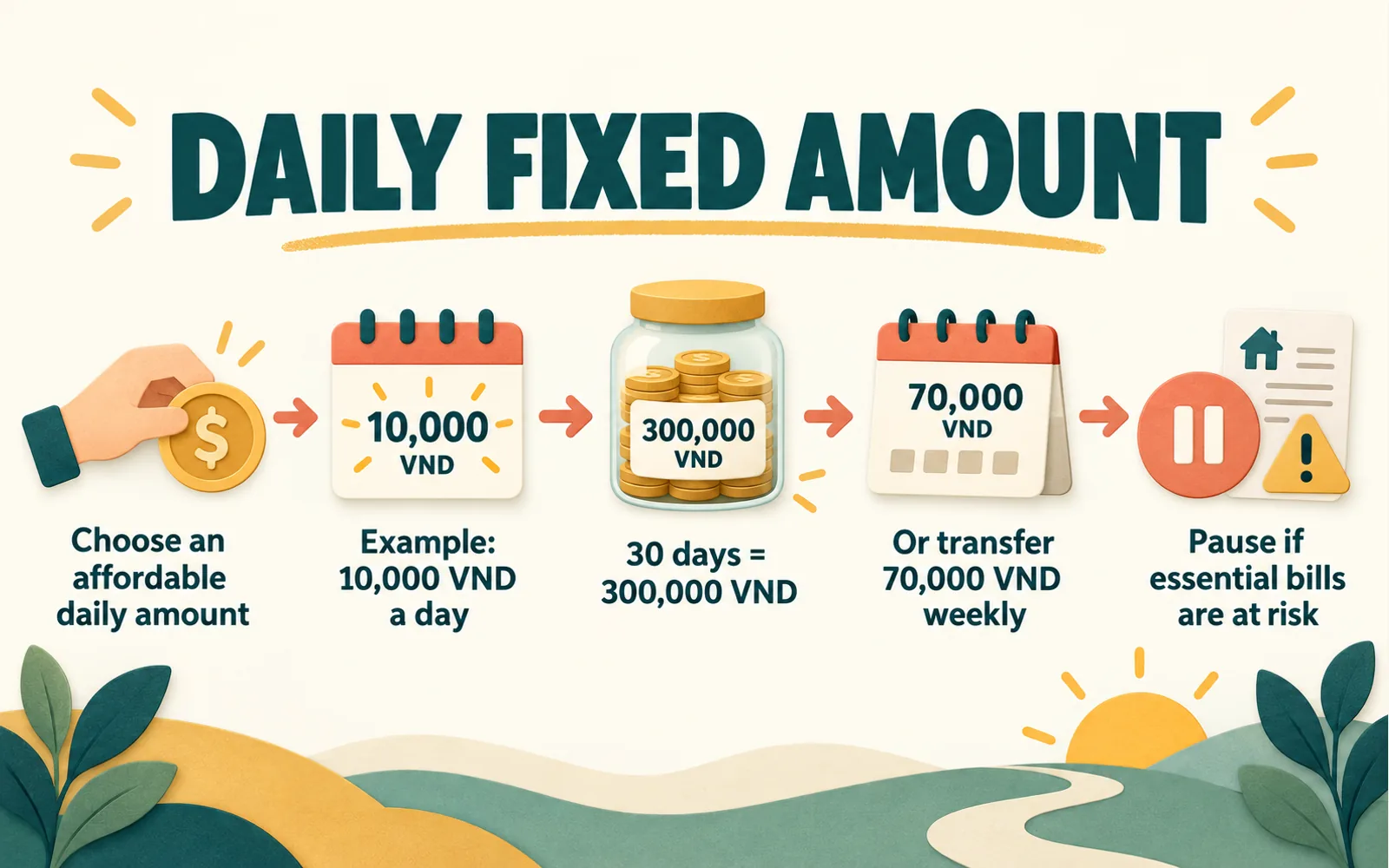
5. Daily Fixed Amount: Remove the Increasing Target
Choose the same affordable amount each day. At 10,000 VND a day, 30 days adds up to 300,000 VND. You can record the daily progress and transfer 70,000 VND weekly if daily bank transfers are inconvenient or carry fees.
Good fit: you prefer a predictable rule to random or increasing contributions. Watch out: a small daily number still has a monthly cost. If money arrives monthly, reserve the affordable amount after payday rather than assuming there will be cash available every morning.
A missed day does not create a debt to the challenge. Resume at an affordable level and record actual contributions, rather than doubling tomorrow’s transfer automatically.
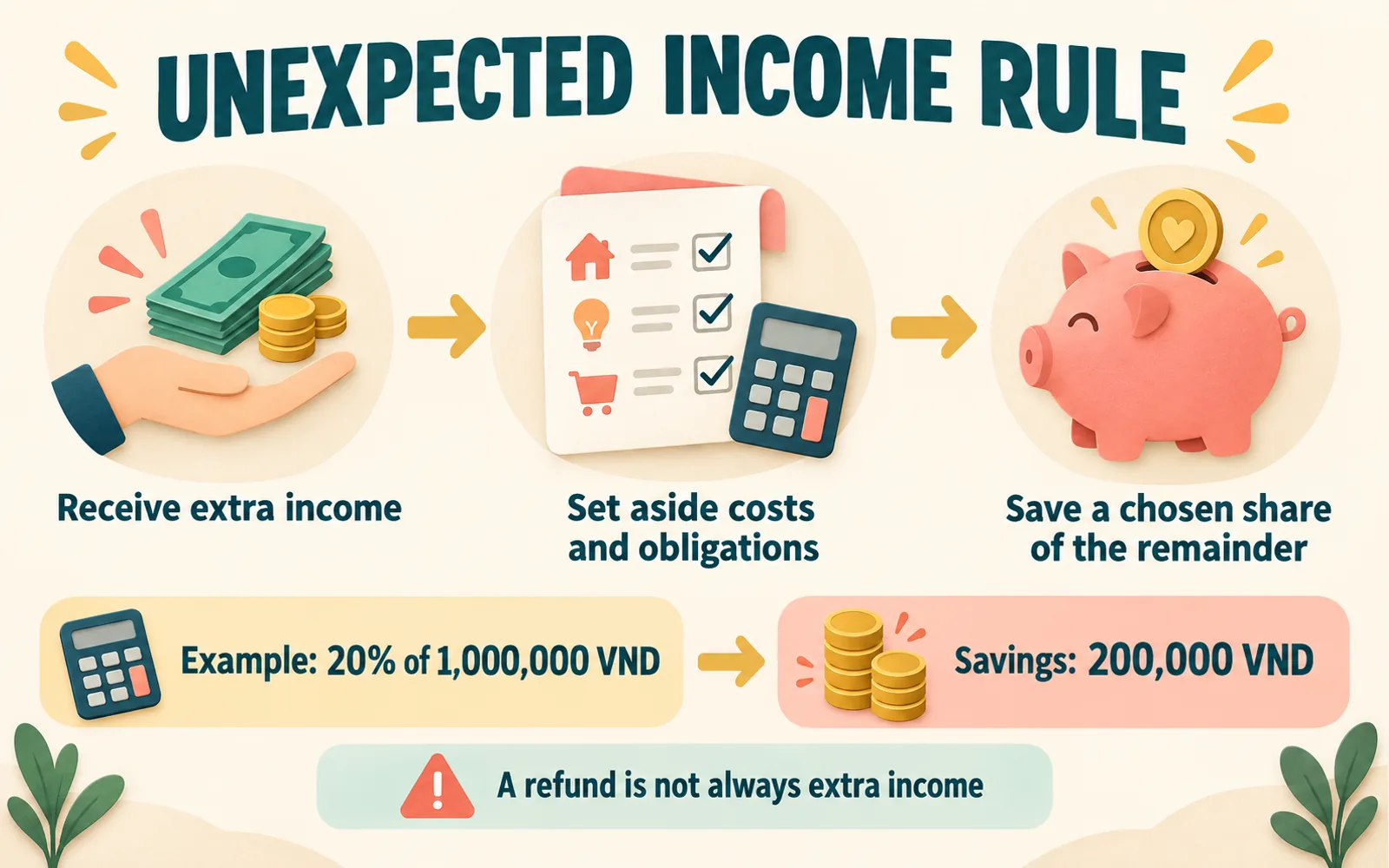
6. Unexpected Income Rule: Decide the Share in Advance
Choose a share of genuinely available extra income to save when it arrives. For example, saving 20% of a 1,000,000 VND remainder after costs and obligations adds 200,000 VND to savings. The percentage is illustrative; no fixed share fits every household.
For side-job pay, first account for expenses and applicable obligations. For a refund, ask whether it needs to repay the original purchase or restore the household budget. A returned payment is not automatically a windfall.
Good fit: you have occasional gifts or extra earnings and want a repeatable decision. Watch out: do not promise future deposits against uncertain income. Record zero when there is no available windfall.
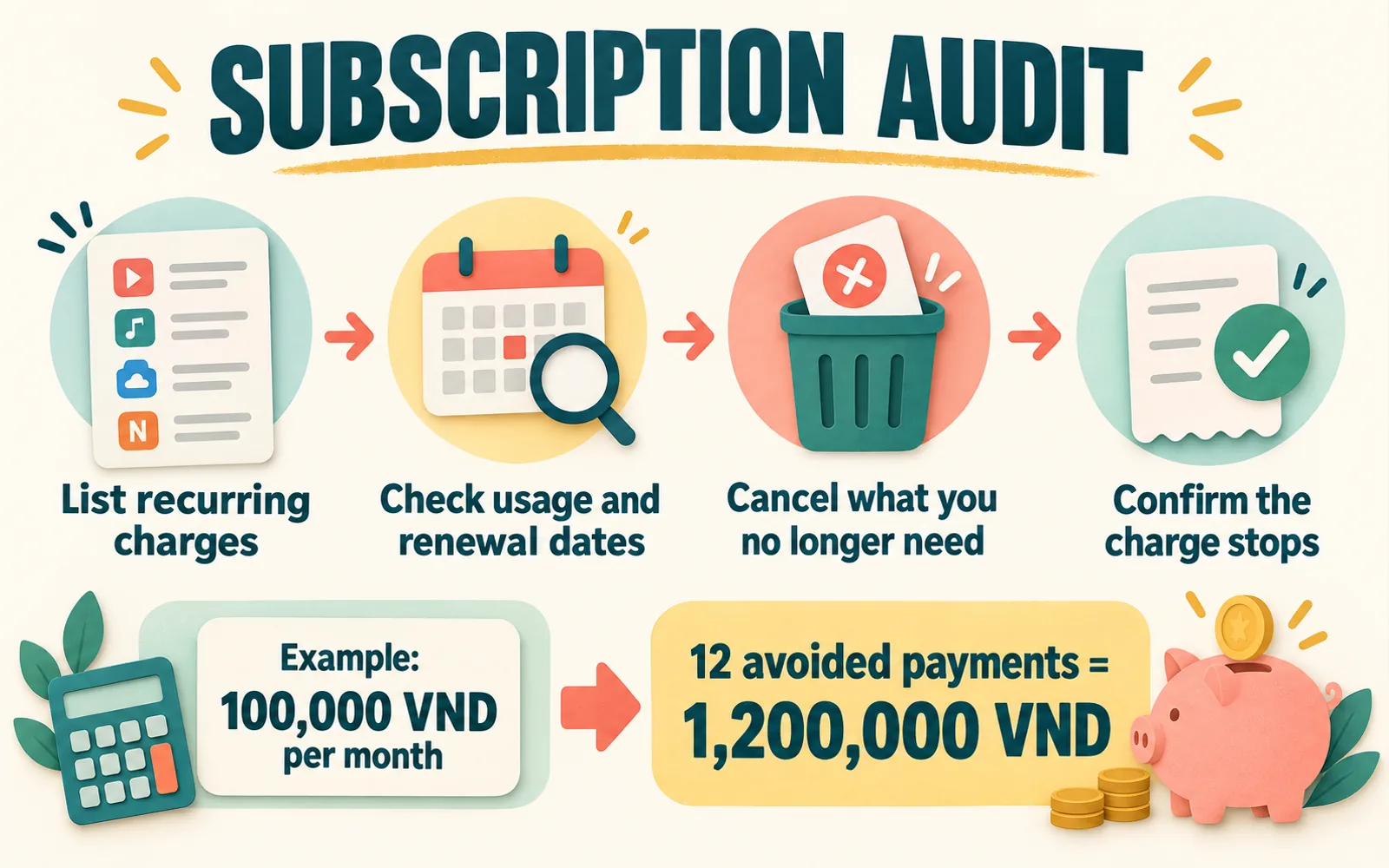
7. Subscription Audit: Turn a Decision into a Verified Reduction
List recurring charges, how often you use them, renewal dates, and cancellation terms. Start with something you no longer need. Cancel through the provider’s process, keep confirmation, and verify the next charge stops.
Avoiding a 100,000 VND monthly charge for 12 future payments frees 1,200,000 VND before replacement costs or cancellation fees. Cancelling an already-paid annual plan may only prevent the next renewal; it does not necessarily return cash today.
Good fit: you suspect recurring spending has become invisible. Watch out: do not count a whole year of avoided charges as money already in savings. Move the amount only as it becomes available and check that a replacement subscription has not absorbed it.
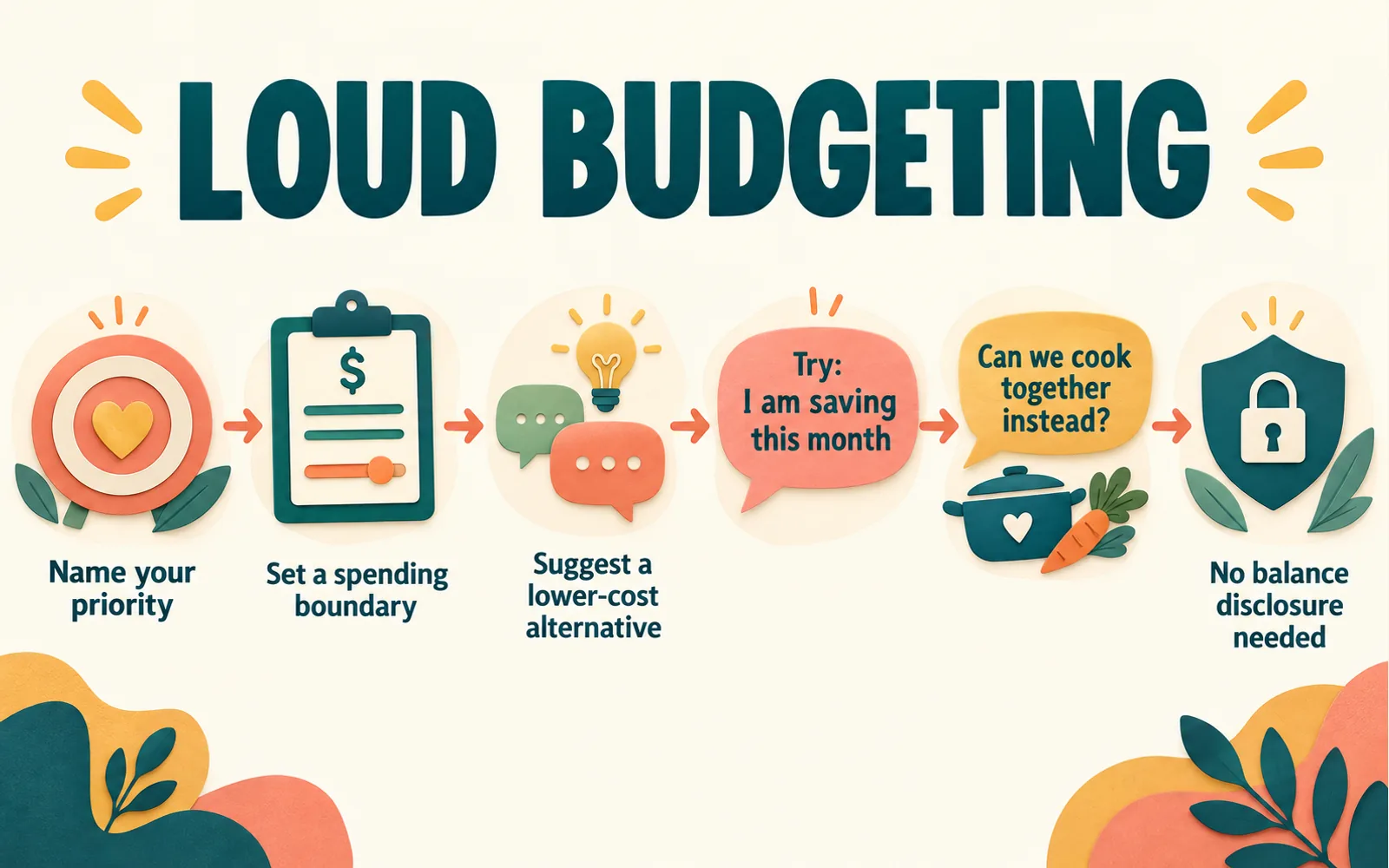
8. Loud Budgeting: Make the Boundary Easy to Say
Loud budgeting is a communication practice: state your spending priority without apologising for it or revealing your finances. “I am saving this month. Can we cook together instead?” gives the other person a concrete alternative.
Choose your own level of disclosure. You do not owe friends a salary figure, account screenshot, or explanation of your debts. In a situation where discussing money feels uncomfortable, a simple “That is outside my budget” is enough.
Good fit: the difficult moment is agreeing to spending in a social setting. Watch out: stating a boundary does not itself create savings. Track what you actually spend on the alternative and what remains.
9. Pay Yourself First: Build the Rule Around Payday
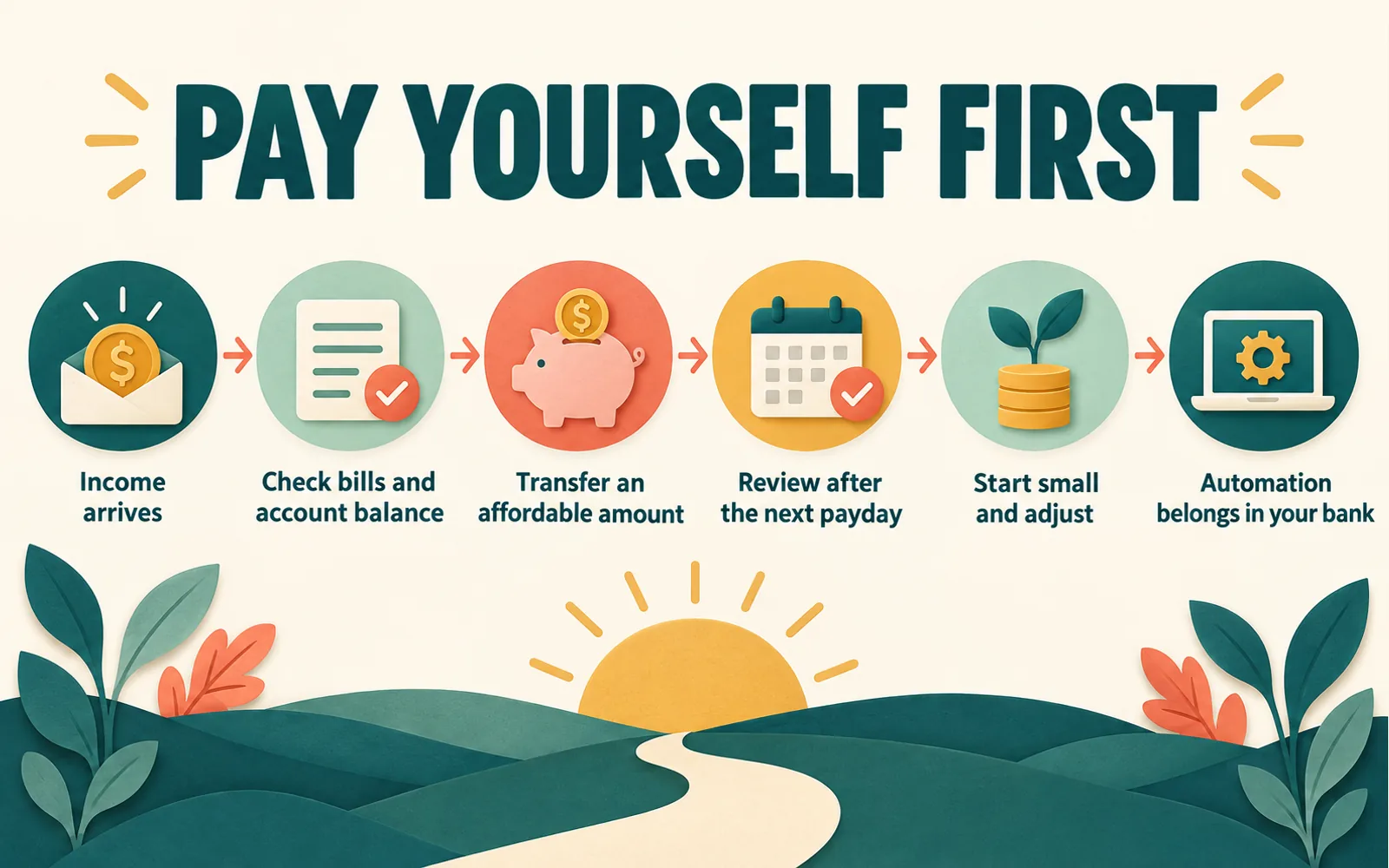
After income arrives, transfer an amount you have budgeted for savings before optional spending absorbs it. “First” describes a planned priority; it does not mean ignoring rent, food, or required payments.
Use your bank’s scheduled-transfer facility if available, check that funds have arrived, and review the balance around bills. Start with an amount that fits instead of assuming everyone should automate 10%. With unpredictable income, a manual check after each payment may fit better than a fixed calendar transfer.
Good fit: you want to keep saving after a challenge ends. Watch out: automation needs review when income, bills, fees, or account terms change.
The CFPB guide describes recurring transfers as a way to make contributions consistent and cautions about insufficient balances and overdraft fees.
What the Evidence Supports—and What It Does Not
The sources here do not establish a head-to-head winner among cash stuffing, 100 envelopes, no-buy periods, and loud budgeting. Our assessments of fit and failure modes are editorial analysis of their rules and cash-flow demands.
A 2022 CFPB study using Qapital app data found that guaranteed rules, such as payday saving, were associated with greater savings accumulation than rules contingent on spending or other events. That is an association in one app’s users, not proof that automation causes better outcomes for everyone or that a particular viral challenge works.
Use the research as support for testing consistent contributions, not as a promise. Challenge totals in this article are arithmetic examples; they exclude interest, fees, missed deposits, and withdrawals.
Research: CFPB: Consumer Savings App Strategies and Savings Outcomes (7 December 2022).
A 30-Day Trial You Can Actually Evaluate
For example, 400,000 VND contributed minus 150,000 VND withdrawn leaves 250,000 VND of net contributions. If you also borrowed 250,000 VND to cover the resulting shortfall, the challenge did not improve your net financial position.
Use Simple Money Tracker to review the purchases behind your experiment and notice whether spending shifts to another category. Keep a note of the challenge rule and actual contributions. A savings transfer moves your own money; do not count it as both consumption and an extra saving. Schedule bank transfers in your bank, then use your records to check the result.
The goal is a savings habit that survives after the hashtag disappears. A quieter rule you can afford is a useful result, even when the original challenge remains unfinished.
- Before day 1: choose one behaviour, write an affordable rule, and record your starting savings balance. For a 52-week or 100-envelope plan, 30 days is a trial rather than completion.
- Week 1: track contributions and relevant purchases. Keep essentials and committed payments funded.
- Weeks 2–3: review once a week. Reduce or pause the rule if it creates a shortfall; do not stack extra challenges to catch up.
- Day 30: total contributions minus withdrawals, excluding interest and unrelated transfers. Then check whether new borrowing, delayed bills, or replacement spending offset the result.
- Next month: keep the part that was easy to repeat. Convert it to a manageable payday or weekly routine if that fits.
Ready to try one? Use our free Saving Challenge Builder to turn any of the nine methods above into a dated plan with your own amounts, rules, and a private checklist you can track in your browser.
Continue Exploring Money Psychology & Better Habits
If tracking itself feels difficult, start with Why Tracking Money Feels Hard. For noticing emotional context around purchases, read Tracking with Heart: The My Mood Journey. To see patterns beyond a short challenge, explore My Stats: See Your Financial Story Unfold Over Time.
Sources and Methodology
This article adapts the SMT saving-challenge plan with AI-assisted drafting and illustrations, source checks, and explicit arithmetic examples. Method selection, practical adaptations, and failure-mode analysis are editorial interpretation, not results of a trial conducted by SMT. This is general education, not personalised financial advice.
Sources were accessed on 8 September 2026. The US sources support general budgeting principles and the specific research discussion; they do not establish Vietnamese banking protections, product availability, or interest rates. VND amounts illustrate the mathematics and are not recommended household budgets.
- Federal Trade Commission: Making a Budget — income, expenses, and reviewing a spending plan.
- CFPB: An essential guide to building an emergency fund — saving routines, account access, cash risks, and transfer timing.
- CFPB: Consumer Savings App Strategies and Savings Outcomes — observational app research, published 7 December 2022.