

An extra shift could pay the electricity bill. It could also take away the only evening you had to rest. A medical appointment could protect your health, but the consultation, transport, and unpaid time away from work all come out of the same small budget. For many people, the conflict is not philosophical. It is Tuesday.
That is why both familiar slogans feel incomplete: "You need money to take care of your health" and "Health is more important than money." Both contain truth. Neither tells you what to do when rent, treatment, and recovery compete for the same resources.
The title is not a claim that trade-offs never exist. They do, sometimes painfully. It is a rejection of treating finance and health as opposing lifetime goals. Financial stability can protect access to care; health can support the ability to earn. A workable plan protects the relationship, not just one side of it.
By Simple Money Tracker | Financial Resilience | Published 4 October 2026. This is an editorial synthesis of public-health sources, not medical, insurance, or individualized financial advice. It has not been clinically reviewed. Health matters in its own right, whether or not someone is able to work.
A better question
Instead of asking which matters more, ask: does my current plan leave enough financial protection to access care, and enough recovery to keep living and working sustainably?
1. Money Protects Access to Health, Not Immunity from Illness
Money can pay for food, stable housing, transport to appointments, and the time to recover. It can also make the difference between filling a prescription today and postponing it until payday. But a high income is not a guarantee of good health, and being ill is not evidence that someone made bad financial choices.
The WHO and World Bank 2025 Universal Health Coverage monitoring report estimates that 2.1 billion people experienced financial hardship from out-of-pocket health spending in 2022. WHO describes this total as including about 1.6 billion people living in poverty or pushed deeper into it by health expenses. These are not 2.1 billion people newly made poor, and they are not measurements of conditions in 2026. [1, 2]
The medicine burden is especially revealing. In three-quarters of countries with available data, medicines accounted for at least 55% of out-of-pocket health expenses, according to the WHO release. That is a share of direct health spending in the countries observed, not 55% of every household budget or a universal percentage for every country. [1]
Financial protection is therefore about more than having a large savings balance. Affordable public services, prepaid coverage, and access to necessary medicines matter too. A household cannot budget its way into a functioning health system. The report explicitly calls for stronger public financing and essential care without point-of-care charges for poor and vulnerable populations. [1, 2]
2. Health Supports Earning, but Overtime Is Not Free Money
A paycheck records the income from extra hours. It does not record everything those hours displace: appointments, sleep, recovery, caregiving, or the capacity to search for a better role. This does not make every demanding week dangerous. It does make permanent overwork worth examining.
A WHO-ILO analysis published in 2021 found that working 55 or more hours per week, compared with 35-40 hours, was associated with an estimated 35% higher risk of stroke and 17% higher risk of dying from ischemic heart disease. These are relative differences, not percentage-point increases in an individual worker's probability. [3]
The agencies estimated 745,000 deaths from these two conditions attributable to long working hours in 2016. The estimate combines evidence synthesis and population modelling; it is not a count of all overtime-related deaths today, or a forecast for someone accepting an extra shift. Nor does the comparison establish that working fewer than 55 hours is automatically safe. [3]
If overtime is necessary to keep food on the table, "just work less" is not a plan. A more honest approach is to name what the extra hours are financing, look for benefits or workplace support that could reduce the pressure, and establish a review point rather than silently making the arrangement permanent. Employers and governments also have responsibility for safe schedules; the solution cannot rest only on individual resilience. [3, 4]
3. A Bigger Salary Does Not Automatically Create Peace of Mind
Income and financial security are related, but they are not identical. Two people with the same pay can have very different obligations, housing costs, support networks, and exposure to income loss. A promotion can improve the numbers while debt payments or family responsibilities still leave little room to breathe.
WHO identifies excessive workloads, low job control, job insecurity, and inadequate pay among risks to mental health at work. It estimates that depression and anxiety account for 12 billion lost working days and US$1 trillion in lost productivity globally each year. These figures concern depression and anxiety, not all stress or burnout, and they do not measure direct medical bills or promise a particular return from a wellbeing purchase. [4]
Health and finances can reinforce each other in either direction: illness can interrupt income while financial insecurity can make life and access to care harder. That is a useful planning perspective, not a diagnosis or proof that debt caused someone's symptoms. Budgeting is not treatment for a mental-health condition.
One terminology distinction matters: WHO classifies burnout as an occupational phenomenon, not a medical condition, in ICD-11. Its definition relates specifically to chronic workplace stress. It should not be used as a catch-all label for depression, anxiety, or exhaustion in every part of life. Seek qualified care for persistent or concerning symptoms rather than trying to diagnose them with a spending spreadsheet. [5]
4. Think in Reinforcing Loops, Not Competing Trophies
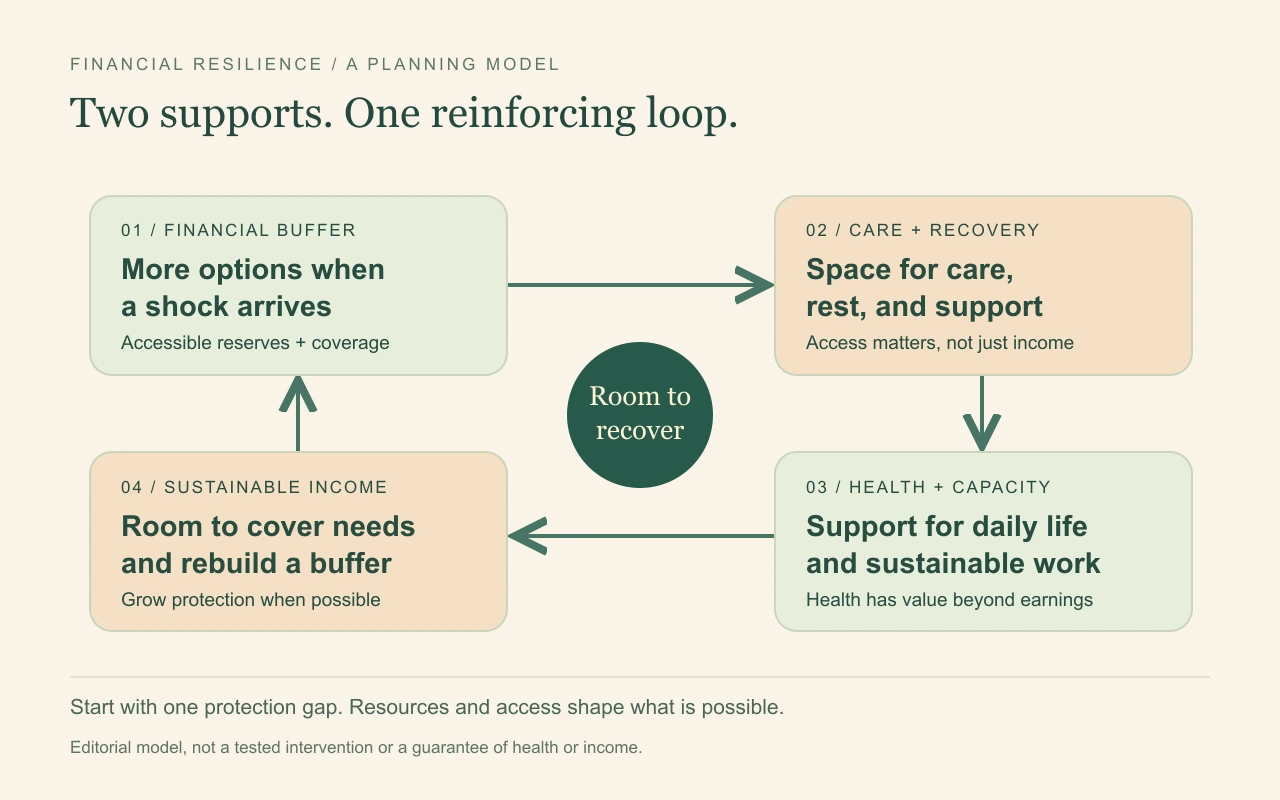
Here is the editorial model: a financial buffer gives you more options when care or time off is needed. Access to care and recovery can help preserve capacity for daily life and work. More stable income then makes rebuilding the buffer easier. None of these links is guaranteed, but they explain why protecting only one side is fragile.
The reverse loop is also possible: an illness interrupts income, a thin buffer forces borrowing, and repayments make the next appointment harder to afford. Or an income target becomes permanent overwork, leaving less capacity to sustain the very earnings it was supposed to increase.
The goal is not to optimize a person like a machine. It is to reduce situations where one shock can damage both health and financial stability at once. Rest and care do not need to justify themselves through higher productivity to be worthwhile.
5. Build a Protection Plan That Fits Your Actual Resources
The following priorities are a practical editorial checklist, not a clinical protocol or a fixed order for every household. Adapt them to your debts, dependants, work arrangements, and local support. If income cannot cover essentials, that is a resource gap to address, not a failure of discipline.
- Protect essentials first. List food, housing, utilities, necessary care, and transport to work. Do not build a savings target by skipping prescribed treatment or basic needs. Discuss cost barriers with a qualified provider or relevant assistance service.
- Know the coverage you already have. Check public or employer health coverage, renewal dates, covered facilities, referral requirements, co-payments, exclusions, and sick-leave arrangements. Coverage for treatment and protection against lost wages are different things. Verify benefits with the insurer or responsible authority; private insurance is not automatically the first purchase.
- Start a small, accessible buffer if there is room. A first target could be one essential bill or the likely cost of transport to an appointment. Increase it gradually as circumstances permit. Keep emergency money separate from money for predictable recurring care, and avoid treating an aspirational multi-month target as a prerequisite for progress.
- Look at debt and cash reserves together. Repayment can reduce expensive interest, but an empty reserve may force new borrowing at the next shock. Review rates, fees, minimum payments, and essential-service risks rather than applying a universal "save first" or "repay everything first" rule.
- Give extra work a purpose and a review date. If you have discretion, define the bill or buffer the extra income will cover and revisit the arrangement after a set period. Where possible, discuss predictable shifts, time for appointments, workload adjustments, or support with your employer or worker representative.
- Review both sides monthly. Check accessible reserves and essential spending alongside whether your schedule leaves room for care and recovery. Persistent health concerns belong with a qualified professional, not only in a budget review.
No buffer should be a barrier to urgent care
This checklist is not a reason to delay urgent medical assessment until a savings target is met. Use appropriate local emergency or healthcare services when needed. Financial planning cannot replace professional care.
6. A Worked Example: The Raise That Looks Larger Than It Is
Consider a fictional worker earning 12 million VND a month, with 10 million VND of essential spending. An extra-work arrangement adds 2 million VND, but requires another 600,000 VND of transport and meals. The direct additional cash is 1.4 million VND, before any tax or other deductions that may apply. These are illustrative numbers, not Vietnamese wage or household averages.
The next question is not whether 1.4 million VND is "worth your health." There is no honest formula that can convert a person's health into that price. Instead ask whether the arrangement covers an immediate need, whether the schedule is sustainable, and whether a lower-cost route could solve the same problem.
If it is a short bridge to an essential payment, with a realistic end point, the decision may be understandable. If each month's additional income is absorbed by new discretionary commitments and there is no end point, the income gain has not created much freedom. The same cash amount can support very different trajectories.
A notebook, spreadsheet, or Simple Money Tracker can help make those direct costs and recurring commitments visible. Record healthcare expenses and predictable bills separately from emergencies, then review what extra work actually leaves after its costs. No tracking tool can diagnose a health problem or guarantee that a job is safe.
7. The Goal Is Room to Recover
Extreme stories make this topic look like a contest: the exhausted high earner versus the person who walked away from ambition. Stories can reveal real harm, but they cannot decide what is feasible for someone with different obligations, health, or support.
You do not need to abandon income growth. You need to notice when growth is buying more resilience and when it is consuming the capacity you rely on. You do not need a perfect emergency fund before taking health seriously. You need a next step small enough to be possible and important enough to matter.
This week, identify one gap: an unclear insurance benefit, a predictable care expense with no plan, a schedule that leaves no room for appointments, or an essential bill that would become debt after an income interruption. Work on that gap first.
Money and health are not interchangeable. They are two supports for a life with options. The aim is not to win the argument about which is more important. It is to keep either one from becoming the reason the other collapses.
Sources and Editorial Limits
Primary pages were accessed on 4 October 2026. Research discovery used Perplexity MCP; cited claims were checked against the WHO and World Bank pages below. This is a narrative editorial synthesis by Simple Money Tracker, not an original study, systematic review, or clinician-authored health guide. No medical reviewer is claimed.
The 2025 UHC report uses revised monitoring indicators and a reproduced historical series. Do not directly compare its headline figures with older reports using different definitions. Its hardship indicator concerns out-of-pocket spending relative to a discretionary budget, not simply any medical expense. The long-hours findings summarize relative risks and modelled population burden, not individual risk predictions. The protection loop and checklist are editorial frameworks, not interventions tested together.
- WHO (6 December 2025). Most countries make progress towards universal health coverage, but major challenges remain. Global hardship estimates for 2022; medicines statistic applies to countries with available data.
- World Bank (5 December 2025). Tracking Universal Health Coverage: 2025 Global Monitoring Report. Explains financial-hardship categories and revised monitoring.
- WHO and ILO (17 May 2021). Long working hours increasing deaths from heart disease and stroke. At least 55 versus 35-40 hours weekly; burden estimate refers to 2016.
- WHO (current fact sheet, accessed 4 October 2026). Mental health at work. Workplace risks, depression/anxiety productivity estimates, and organizational responsibilities.
- WHO (28 May 2019). Burn-out an occupational phenomenon: International Classification of Diseases. ICD-11 terminology; not a medical diagnosis.
Continue Reading
For the income side of resilience, read Saving vs. Earning More: The False Choice That Keeps People Stuck. To distinguish security from pressure to look successful, see Financial FOMO. For a longer view of your own numbers, continue with Personal Finance Over Time.