

In a July 2026 interview with The Economist editor-in-chief Zanny Minton Beddoes, recorded at Tesla’s Texas Gigafactory, Elon Musk made one of his most sweeping economic claims yet: by around 2036, money will no longer matter.
The statement was not casual. It sits right at the center of his long-running thesis about artificial intelligence, humanoid robots, and the transition into a post-scarcity civilization.
1. What Musk Actually Said
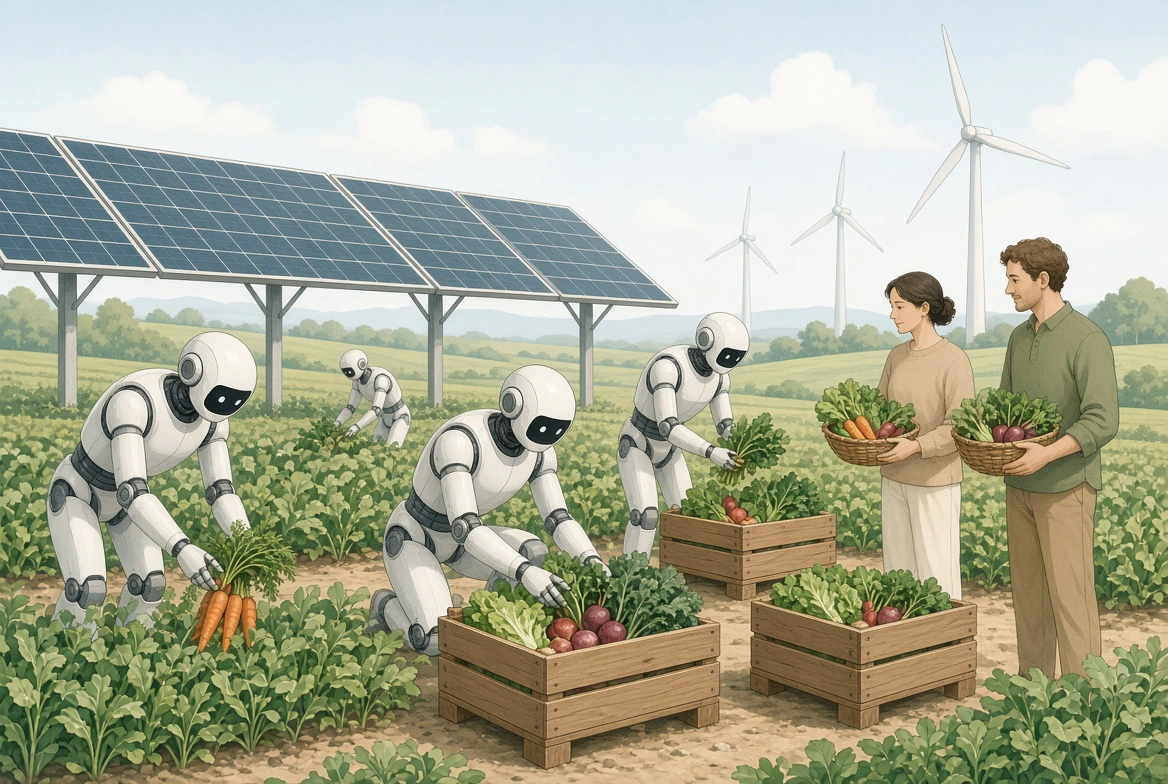
Musk’s core logic is straightforward. People want money because they need goods and services — food, housing, transportation, entertainment, and healthcare. If AI and vast fleets of general-purpose robots can produce those essentials in quantities far beyond what humanity can consume, the traditional reason for money disappears.
“You want money for food, housing, transport, entertainment,” he said. “If that is so abundant… what do you need money for in that case?”
He went further on the monetary consequences. Conventional economics worries that printing money causes runaway inflation. Musk argued the exact opposite will happen in an AI-driven automated economy: if the output of goods and services grows dramatically faster than the money supply, the result is structural deflation, not inflation.
In that environment, he suggested, governments could issue checks to citizens — a form of “universal high income” — without triggering the usual inflationary spiral.
The Post-Scarcity Premise
Musk draws direct inspiration from Iain M. Banks’ Culture sci-fi universe: a civilization where physical labor is optional, energy and production are essentially unlimited, and classical currency ceases to be the gatekeeper of human well-being.
2. The Strength of the Argument: Energy and Mass as True Currency
There is a coherent internal logic here. Money is ultimately a claim on scarce resources and human labor. If intelligent machines can manufacture almost anything at near-zero marginal cost, the scarcity that gives money its leverage weakens. History shows that technological leaps have repeatedly driven down the real cost of compute, communication, and basic manufactured goods. Extending that trend to broad physical production is not absurd on its face.
Musk is also right to highlight energy as a deeper, unyielding constraint. In several related discussions, he has described energy (wattage) and mass (tonnage) as the fundamental currencies of an advanced civilization. Unlike fiat money or digital balances, energy cannot be printed by decree or inflated away.
From Fiat to Physics
When compute and physical labor become infinite commodities, the ultimate bottleneck shifts to fundamental physics: raw materials, thermal limits, and clean energy generation.
3. Where the Argument Weakens: Distribution, Transition, and Human Nature
While the theoretical physics of abundance might check out, the socio-economic reality is significantly messier:
- The Distribution Problem: Even if robots produce abundance, someone still owns the robots, the factories, the data centers, and the energy grids. Ownership does not automatically dissolve because production rises. Without deliberate political and institutional design, extreme abundance can coexist with extreme inequality.
- The Friction of Transition: The decade or two before full abundance would likely involve massive labor disruption. “Universal high income” requires governments capable of taxing or directing automated capital at an unprecedented scale — a political challenge far beyond existing welfare apparatuses.
- Positional Goods & Status: Even in a world of material plenty, humans naturally compete for status, unique experiences, prime geographic locations, prestige, and influence. These things remain scarce by definition, and economic ranking mechanisms will always arise around whatever remains limited.
- Aggressive Timeline: Deploying billions of dexterous, reliable, low-cost humanoid robots across all sectors of the global economy by 2036 remains a massive technological and logistic hurdle.
4. A More Useful Way to Read the Claim
The most productive takeaway is not to treat “2036” as an exact expiration date for currency, but rather to recognize that the relationship between labor, capital, and money is undergoing a generational shift.
In that frame, several practical questions become far more urgent than waiting for money to evaporate:
- How will societies tax and fairly distribute the dividends of highly automated systems?
- What happens to the purchasing power of financial savings if the cost of physical goods plummets while land and energy appreciate?
- Which skills, human connections, and unique assets retain scarcity value when physical manufacturing is no longer the bottleneck?
- How do individuals maintain financial resilience and agility during the turbulent years of the AI transition?
Focus on What You Can Control
Abundance is not automatically shared; it must be architected. In the meantime, managing your personal cash flows, building tangible skills, and tracking your wealth remain the most reliable anchors for financial freedom.